
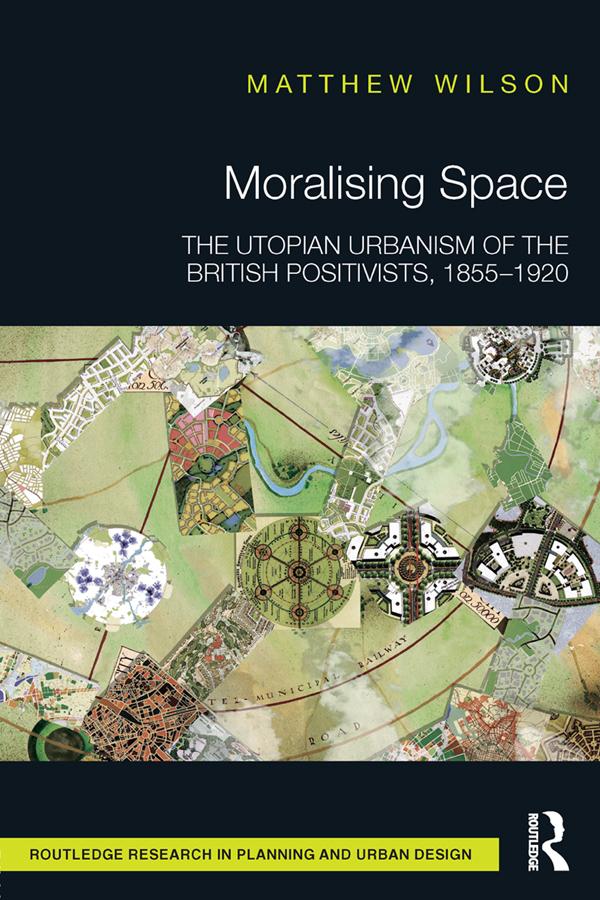
Amidst the soot, stink and splendour of Victorian London, a coterie of citizen-sociologists set out to break up the British Empire. They were the followers of the French philosopher Auguste Comte, a controversial figure who introduced the modern science of sociology and the republican Religion of Humanity. Moralising Space examines how from the 1850s Comte’s British followers practised this science and religion with the aim to create a global network of 500 utopian city-states.
Curiously the British Positivists’ work has never been the focus of a full-length study on modern sociology and town planning. In this intellectual history, Matthew Wilson shows that through to the interwar period affiliates to the British Positivist Society – Richard Congreve, Frederic Harrison, Charles Booth, Patrick Geddes and Victor Branford – attempted to realise Comte’s vision. With scarcely used source material Wilson presents the Positivists as an organised resistance to imperialism, industrial exploitation, poverty and despondency. Much to the consternation of the church, state and landed aristocracy they organised urban interventions, led ad hoc sociological surveys and published programmes for realising idyllic city-communities. Effectively this book contributes to our understanding of how Positivism, as a utopian spatial design praxis, heavily influenced twentieth-century architecture and planning.
Płać wygodnie kartą, Klarną, Apple Pay lub Google Pay. Nie jesteś zadowolony? Zawsze masz 14-dniową gwarancję zwrotu pieniędzy. Więcej przeczytasz w naszych warunkach. Masz pytania? Napisz do nas na hello@memmo.org.
Memmo ułatwia naukę – gdziekolwiek jesteś na świecie. U nas znajdziesz podręczniki i sprytne narzędzia do nauki w jednym miejscu: streszczenia, quizy, podcasty i fiszki. A do tego Ted, Twój kumpel do nauki, który odpowie na wszystko, co Cię nurtuje. Ponad 50 000 studentów już tu się uczy – stworzone, byś uczył się szybciej i mniej stresował.