
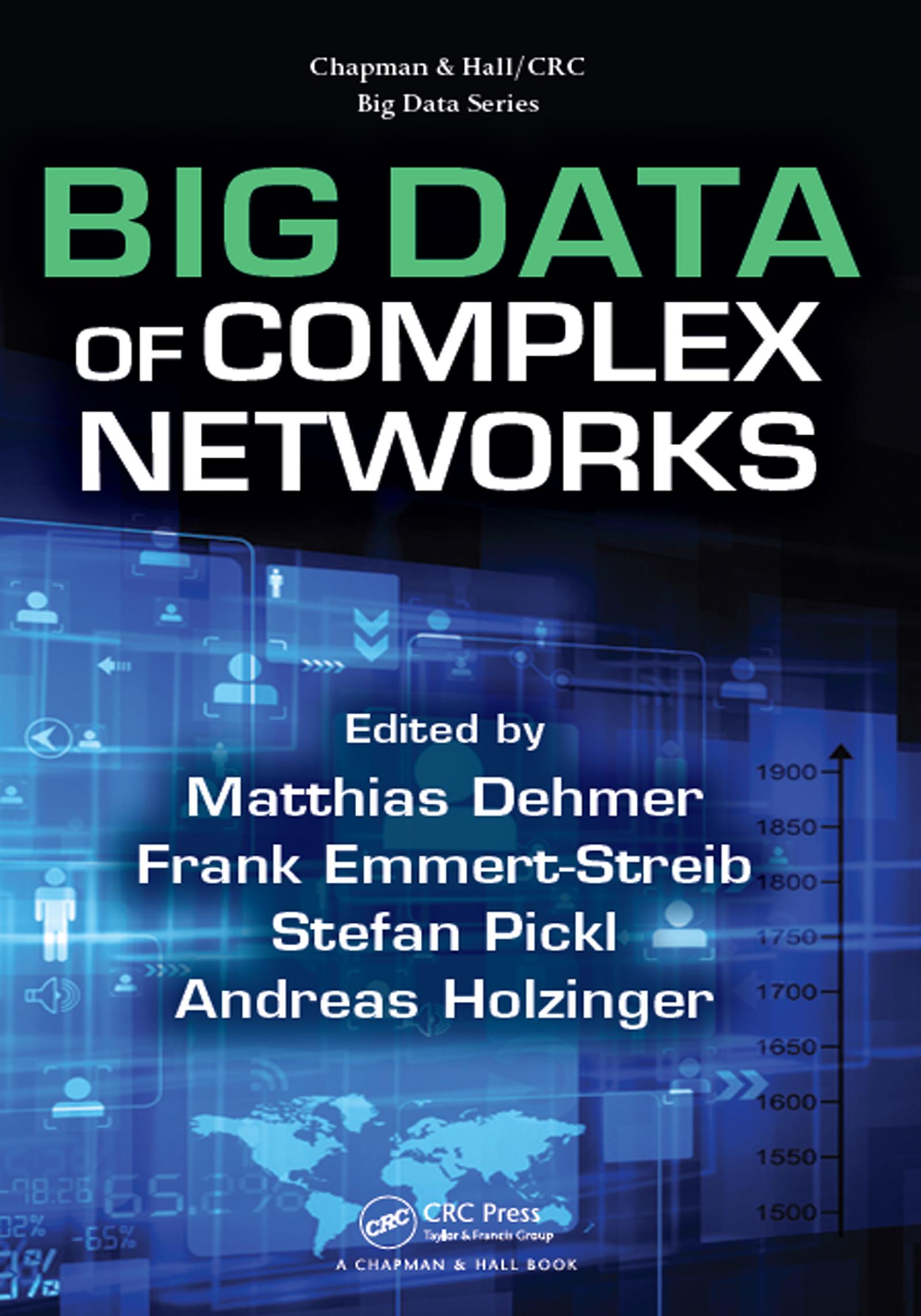
Big Data of Complex Networks presents and explains the methods from the study of big data that can be used in analysing massive structural data sets, including both very large networks and sets of graphs. As well as applying statistical analysis techniques like sampling and bootstrapping in an interdisciplinary manner to produce novel techniques for analyzing massive amounts of data, this book also explores the possibilities offered by the special aspects such as computer memory in investigating large sets of complex networks.
Intended for computer scientists, statisticians and mathematicians interested in the big data and networks, Big Data of Complex Networks is also a valuable tool for researchers in the fields of visualization, data analysis, computer vision and bioinformatics.
Key features:
- Provides a complete discussion of both the hardware and software used to organize big data
- Describes a wide range of useful applications for managing big data and resultant data sets
- Maintains a firm focus on massive data and large networks
- Unveils innovative techniques to help readers handle big data
Matthias Dehmer received his PhD in computer science from the Darmstadt University of Technology, Germany. Currently, he is Professor at UMIT – The Health and Life Sciences University, Austria, and the Universität der Bundeswehr München. His research interests are in graph theory, data science, complex networks, complexity, statistics and information theory.
Frank Emmert-Streib received his PhD in theoretical physics from the University of Bremen, and is currently Associate professor at Tampere University of Technology, Finland. His research interests are in the field of computational biology, machine learning and network medicine.
Stefan Pickl holds a PhD in mathematics from the Darmstadt University of Technology, and is currently a Professor at Bundeswehr Universität München. His research interests are in operations research, systems biology, graph theory and discrete optimization.
Andreas Holzinger received his PhD in cognitive science from Graz University and his habilitation (second PhD) in computer science from Graz University of Technology. He is head of the Holzinger Group HCI-KDD at the Medical University Graz and Visiting Professor for Machine Learning in Health Informatics Vienna University of Technology.
Płać wygodnie kartą, Klarną, Apple Pay lub Google Pay. Nie jesteś zadowolony? Zawsze masz 14-dniową gwarancję zwrotu pieniędzy. Więcej przeczytasz w naszych warunkach. Masz pytania? Napisz do nas na hello@memmo.org.
Memmo ułatwia naukę – gdziekolwiek jesteś na świecie. U nas znajdziesz podręczniki i sprytne narzędzia do nauki w jednym miejscu: streszczenia, quizy, podcasty i fiszki. A do tego Ted, Twój kumpel do nauki, który odpowie na wszystko, co Cię nurtuje. Ponad 50 000 studentów już tu się uczy – stworzone, byś uczył się szybciej i mniej stresował.