
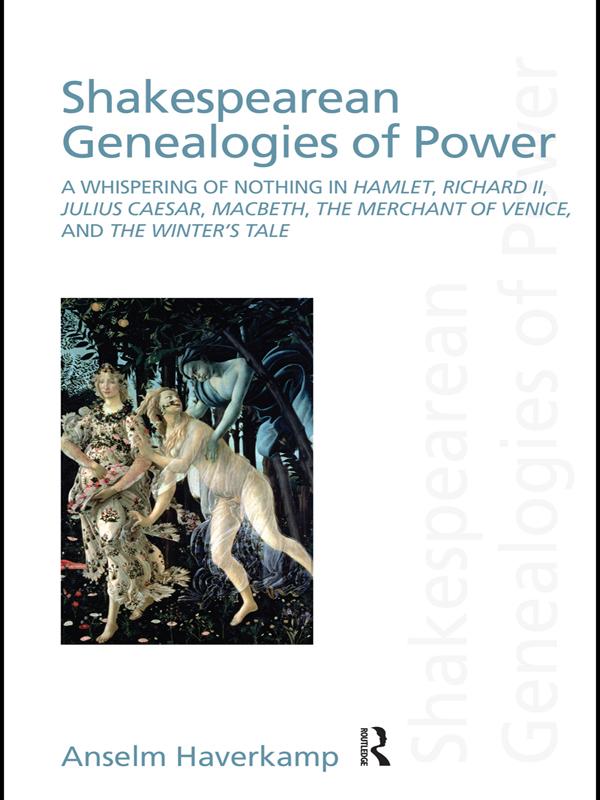
Shakespearean Genealogies of Power proposes a new view on Shakespeare’s involvement with the legal sphere: as a visible space between the spheres of politics and law and well able to negotiate legal and political, even constitutional concerns, Shakespeare’s theatre opened up a new perspective on normativity. His plays reflect, even create, "history" in a new sense on the premises of the older conceptions of historical and legal exemplarity: examples, cases, and instances are to be reflected rather than treated as straightforwardly didactic or salvific. Thus, what comes to be recognized, reflected and acknowledged has a disowning, alienating effect, whose enduring aftermath rather than its theatrical immediacy counts and remains effective. In Shakespeare, the law gets hold of its normativity as the problematic efficacy of unsolved – or rarely ever completely solved – problems: on the stage of the theatre, the law has to cope with a mortgage of history rather than with its own success story. The exemplary interplay of critical cultural and legal theory in the twentieth-century – between Carl Schmitt and Hans Kelsen, Walter Benjamin and Ernst Kantorowicz, Hans Blumenberg and Giorgio Agamben, Robert Cover and Niklas Luhmann – found in Shakespeare’s plays its speculative instruments.
Płać wygodnie kartą, Klarną, Apple Pay lub Google Pay. Nie jesteś zadowolony? Zawsze masz 14-dniową gwarancję zwrotu pieniędzy. Więcej przeczytasz w naszych warunkach. Masz pytania? Napisz do nas na hello@memmo.org.
Memmo ułatwia naukę – gdziekolwiek jesteś na świecie. U nas znajdziesz podręczniki i sprytne narzędzia do nauki w jednym miejscu: streszczenia, quizy, podcasty i fiszki. A do tego Ted, Twój kumpel do nauki, który odpowie na wszystko, co Cię nurtuje. Ponad 50 000 studentów już tu się uczy – stworzone, byś uczył się szybciej i mniej stresował.