
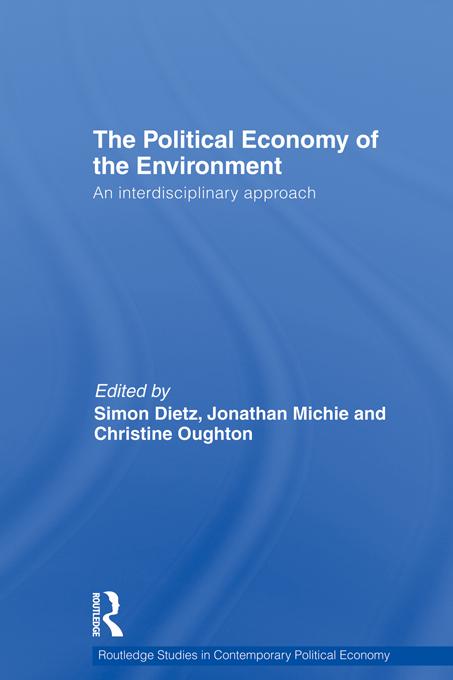
This book is the culmination of several years work by a group of academics, policy-makers and other professionals looking to understand how alternative economic thinking – and indeed thinking from quite different social-scientific disciplines – could enhance the mainstream economic approach to environmental and natural-resource problems. Of the editors, Dietz comes from the mainstream economics tradition, while Michie and Oughton draw explicitly on institutional and evolutionary economics. The various authors represent a range of disciplinary backgrounds and approaches. This book draws on the strengths of each and all of these approaches to analyse environmental issues and what can be done to tackle these through corporate and public policy.
The book argues that the need for an inter-disciplinary approach. Two themes which emerge repeatedly throughout the book are the need for an interdisciplinary theory of technological change, and the need for a similarly interdisciplinary approach to the study of human behaviour and how it influences both production and consumption choices. The two themes are of course related. Resolving environmental questions requires an understanding of their nature, of their causes and, to the extent that they are anthropogenic, of how to change human behaviour. These fundamental issues are the focus of the four chapters that form Part 1 of this volume. The remainder of the volume develops them in more detail.
.
Płać wygodnie kartą, Klarną, Apple Pay lub Google Pay. Nie jesteś zadowolony? Zawsze masz 14-dniową gwarancję zwrotu pieniędzy. Więcej przeczytasz w naszych warunkach. Masz pytania? Napisz do nas na hello@memmo.org.
Memmo ułatwia naukę – gdziekolwiek jesteś na świecie. U nas znajdziesz podręczniki i sprytne narzędzia do nauki w jednym miejscu: streszczenia, quizy, podcasty i fiszki. A do tego Ted, Twój kumpel do nauki, który odpowie na wszystko, co Cię nurtuje. Ponad 50 000 studentów już tu się uczy – stworzone, byś uczył się szybciej i mniej stresował.