
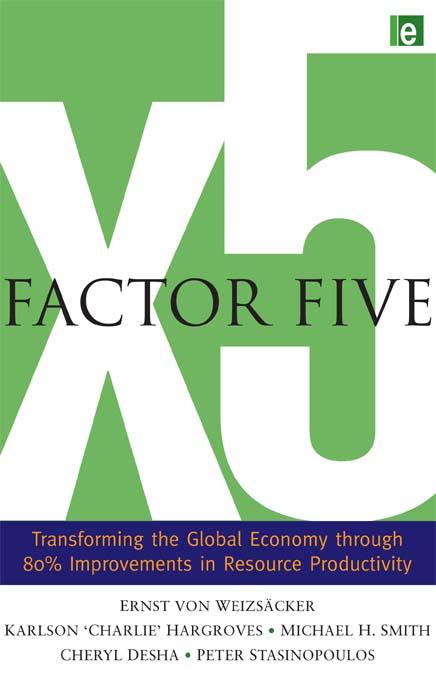
When first published in 1997, Factor Four: Doubling Wealth, Halving Resource Use by renowned economic and engineering experts Ernst von Weizsäcker, Amory Lovins and L. Hunter Lovins, transformed how economists, policy makers, engineers, entrepreneurs and business leaders thought about innovation and wealth creation. Through examples from a wide range of industrial sectors, the authors demonstrated how technical innovation could cut resource use in half while doubling wealth. Now twelve years on, with climate change at the top of the world agenda and the new economic giants of China and India needing ever more resources, there is a unique historic opportunity to scale up resources productivity and radically transform the global economy. And Factor Five is the book set to change all of this.
Picking up where Factor Four left off, this new book examines the past 15 years of innovation in industry, technical innovation and policy. It shows how and where factor four gains have been made and how we can achieve greater factor five or 80%+ improvements in resource and energy productivity and how to roll them out on a global scale to retool our economic system, massively boost wealth for billions of people around the world and help solve the climate change crises.
Spanning dozens of countries including China and India and examining innumerable cases of innovation in design, technology and policy, the authors leave no engineering and economic stone unturned in their quest for excellence. The book tackles sustainable development and climate change by providing in depth Factor 5 resource productivity studies of the following sectors: Buildings, Industry, Agriculture, Food and Hospitality, and Transportation. In its systematic approach to demonstrating how Factor 5 can be achieved, the book also provides an overview of energy/water nexus and energy/materials nexus efficiency opportunities across these sectors. Given that these sectors are responsible for virtually all energy usage and greenhouse gas emissions globally, this book is designed to guide everyone from individual households, businesses, industry sector groups to national governments in their efforts to achieve the IPCC recommended target of 80 per cent reductions to greenhouse gas emissions. It also looks at innovation in regulation to increase resource productivity, pricing, carbon trading, eco-taxation and permits and the role of international institutions and trade. The authors also explain exciting new concepts such as bio-mimicry and whole system design, as hallmarks for a new generation of technologies. The last part of the book explores transformative ideas such as a long term trajectory of gently rising energy and resource prices, and new concepts of well-being in a more equitable world.
Like its predecessor this book is simply the most important work on the future of innovation, business, economics and policy and is top drawer reading for leaders across all sectors including business and industry, government, engineering and design and teaching.
This book is full colour throughout.
Published with The Natural Edge Project
Płać wygodnie kartą, Klarną, Apple Pay lub Google Pay. Nie jesteś zadowolony? Zawsze masz 14-dniową gwarancję zwrotu pieniędzy. Więcej przeczytasz w naszych warunkach. Masz pytania? Napisz do nas na hello@memmo.org.
Memmo ułatwia naukę – gdziekolwiek jesteś na świecie. U nas znajdziesz podręczniki i sprytne narzędzia do nauki w jednym miejscu: streszczenia, quizy, podcasty i fiszki. A do tego Ted, Twój kumpel do nauki, który odpowie na wszystko, co Cię nurtuje. Ponad 50 000 studentów już tu się uczy – stworzone, byś uczył się szybciej i mniej stresował.