
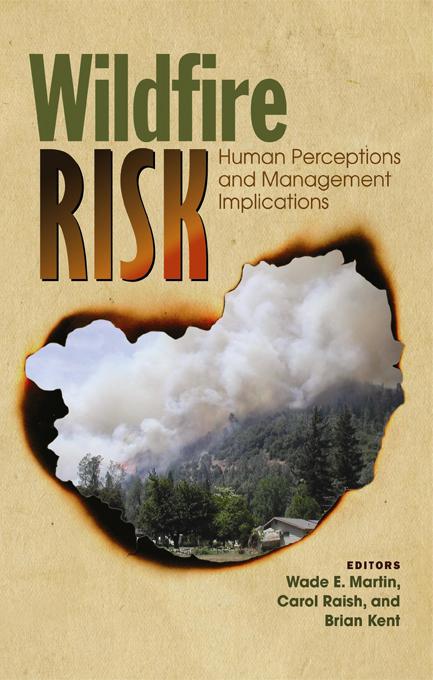
The continuing encroachment of human settlements into fire-prone areas and extreme fire seasons in recent years make it urgent that we better understand both the physical and human dimensions of managing the risk from wildfire. Wildfire Risk follows from our awareness that increasing public knowledge about wildfire hazard does not necessarily lead to appropriate risk reduction behavior. Drawing heavily upon health and risk communication, and risk modeling, the authors advance our understanding of how individuals and communities respond to wildfire hazard. They present results of original research on the social, economic, and psychological factors in responses to risk, discuss how outreach and education can influence behavior, and consider differences among ethnic/racial groups and between genders with regard to values, views, and attitudes about wildfire risk. They explore the role of public participation in risk assessment and mitigation, as well as in planning for evacuation and recovery after fire. Wildfire Risk concludes with a dedicated section on risk-modeling, with perspectives from decision sciences, geography, operations research, psychology, experimental economics, and other social sciences.
Płać wygodnie kartą, Klarną, Apple Pay lub Google Pay. Nie jesteś zadowolony? Zawsze masz 14-dniową gwarancję zwrotu pieniędzy. Więcej przeczytasz w naszych warunkach. Masz pytania? Napisz do nas na hello@memmo.org.
Memmo ułatwia naukę – gdziekolwiek jesteś na świecie. U nas znajdziesz podręczniki i sprytne narzędzia do nauki w jednym miejscu: streszczenia, quizy, podcasty i fiszki. A do tego Ted, Twój kumpel do nauki, który odpowie na wszystko, co Cię nurtuje. Ponad 50 000 studentów już tu się uczy – stworzone, byś uczył się szybciej i mniej stresował.
Może Ci się spodobać
Kup książkę0