
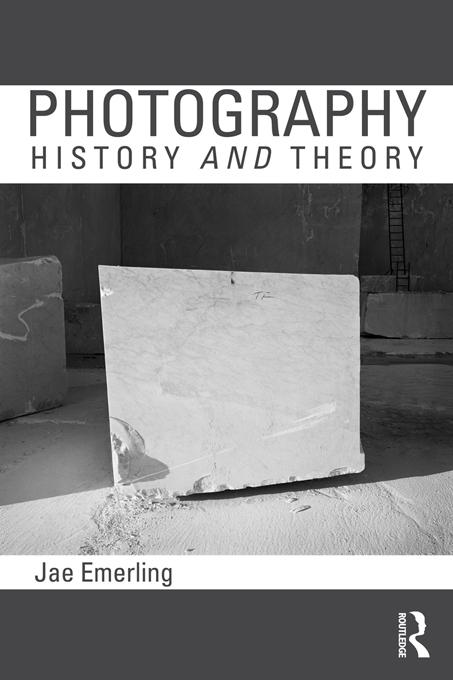
Photography: History and Theory introduces students to both the history of photography and critical theory.
From its inception in the nineteenth century, photography has instigated a series of theoretical debates. In this new text, Jae Emerling therefore argues that the most insightful way to approach the histories of photography is to address simultaneously the key events of photographic history alongside the theoretical discourse that accompanied them.
While the nineteenth century is discussed, the central focus of the text is on modern and contemporary photographic theory. Particular attention is paid to key thinkers, such as Baudelaire, Barthes and Sontag. In addition, the centrality of photography to contemporary art practice is addressed through the theoretical work of Allan Sekula, John Tagg, Rosalind Krauss, and Vilém Flusser. The text also includes readings of many canonical photographers and exhibitions including: Atget, Brassai, August Sander, Walker Evans, The Family of Man, Diane Arbus, Lee Friedlander, Cindy Sherman, Bernd and Hilla Becher, Sebastaio Salgado, Jeff Wall, and others.
In addition, Emerling provides close readings of key passages from some major theoretical texts. These glosses come between the chapters and serve as a conceptual line that connects them. Glosses include:
- Roland Barthes, "The Rhetoric of the Image" (1964)
- Susan Sontag, Regarding the Pain of Others (2002)
- Michel Foucault on the archive (1969)
- Walter Benjamin, "Little History of Photography" (1931)
- Vilém Flusser, Towards a Philosophy of Photography (1983)
A substantial glossary of critical terms and names, as well as an extensive bibliography, make this the ideal book for courses on the history and theory of photography.
Płać wygodnie kartą, Klarną, Apple Pay lub Google Pay. Nie jesteś zadowolony? Zawsze masz 14-dniową gwarancję zwrotu pieniędzy. Więcej przeczytasz w naszych warunkach. Masz pytania? Napisz do nas na hello@memmo.org.
Memmo ułatwia naukę – gdziekolwiek jesteś na świecie. U nas znajdziesz podręczniki i sprytne narzędzia do nauki w jednym miejscu: streszczenia, quizy, podcasty i fiszki. A do tego Ted, Twój kumpel do nauki, który odpowie na wszystko, co Cię nurtuje. Ponad 50 000 studentów już tu się uczy – stworzone, byś uczył się szybciej i mniej stresował.