
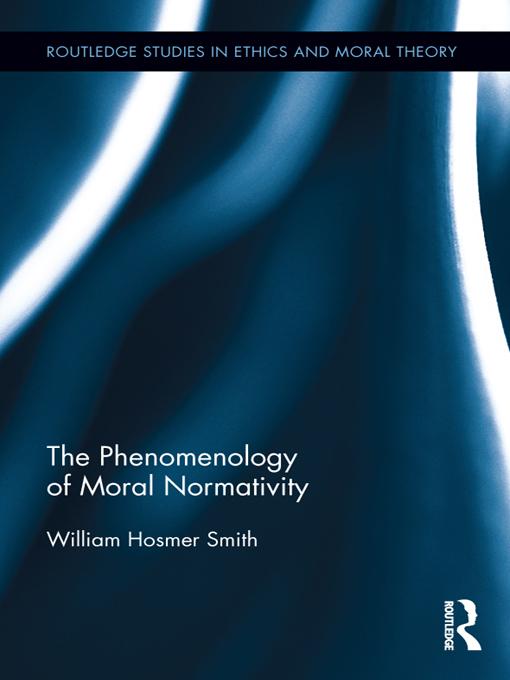
Why should I be moral? Philosophers have long been concerned with the legitimacy of morality’s claim on us—especially its ostensible aim to motivate certain actions of all persons unconditionally. This problem of moral normativity has received extensive treatment in analytic moral theory, but little attention has been paid to the potential contribution that phenomenology might make to this central debate in metaethics.
In The Phenomenology of Moral Normativity, William H. Smith takes up the question of morality’s legitimacy anew, drawing contemporary moral philosophers into conversation with the phenomenological philosophy of Husserl, Heidegger, and Levinas. Utilizing a two-part account of moral normativity, Smith contends that the ground of morality itself is second-personal—rooted in the ethical demand intrinsic to other persons —while the ground for particular moral-obligations is first-personal—rooted in the subject’s avowal or endorsement of certain moral norms within a concrete historical situation.
Thus, Smith argues, phenomenological analysis allows us to make sense of an idea that has long held intuitive appeal, but that modern moral philosophy has been unable to render satisfactorily: namely, that the normative source of valid moral claims is simply other persons and what we owe to them.
Płać wygodnie kartą, Klarną, Apple Pay lub Google Pay. Nie jesteś zadowolony? Zawsze masz 14-dniową gwarancję zwrotu pieniędzy. Więcej przeczytasz w naszych warunkach. Masz pytania? Napisz do nas na hello@memmo.org.
Memmo ułatwia naukę – gdziekolwiek jesteś na świecie. U nas znajdziesz podręczniki i sprytne narzędzia do nauki w jednym miejscu: streszczenia, quizy, podcasty i fiszki. A do tego Ted, Twój kumpel do nauki, który odpowie na wszystko, co Cię nurtuje. Ponad 50 000 studentów już tu się uczy – stworzone, byś uczył się szybciej i mniej stresował.