
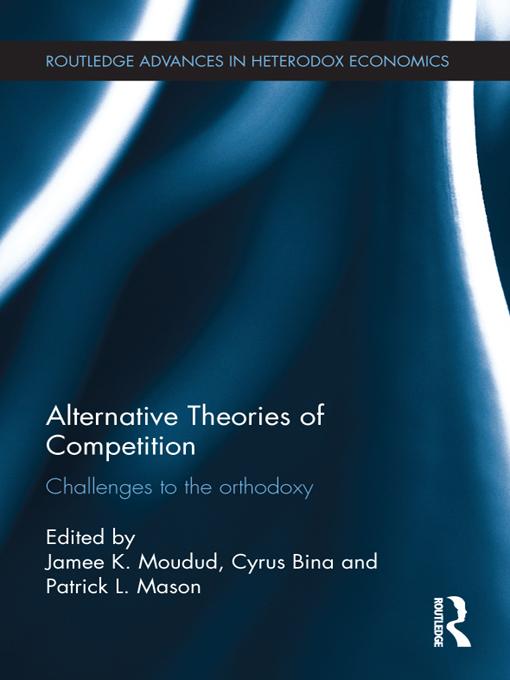
The history of policymaking has been dominated by two rival assumptions about markets. Those who have advocated Keynesian-type policies have generally based their arguments on the claim that markets are imperfectly competitive. On the other hand laissez faire advocates have argued the opposite by claiming that in fact free market policies will eliminate "market imperfections" and reinvigorate perfect competition. The goal of this book is to enter into this important debate by raising critical questions about the nature of market competition.
Drawing on the insights of the classical political economists, Schumpeter, Hayek, the Oxford Economists’ Research Group (OERG) and others, the authors in this book challenge this perfect versus imperfect competition dichotomy in both theoretical and empirical terms. There are important differences between the theoretical perspectives of several authors in the broad alternative theoretical tradition defined by this book; nevertheless, a unifying theme throughout this volume is that competition is conceptualized as a dynamic disequilibrium process rather than the static equilibrium state of conventional theory. For almost all the others the growth of firm is consistent with a heightened degree of competitiveness, as both Marx and Schumpeter emphasized, and not a lowered one as in the conventional 'monopoly capital' view.
Płać wygodnie kartą, Klarną, Apple Pay lub Google Pay. Nie jesteś zadowolony? Zawsze masz 14-dniową gwarancję zwrotu pieniędzy. Więcej przeczytasz w naszych warunkach. Masz pytania? Napisz do nas na hello@memmo.org.
Memmo ułatwia naukę – gdziekolwiek jesteś na świecie. U nas znajdziesz podręczniki i sprytne narzędzia do nauki w jednym miejscu: streszczenia, quizy, podcasty i fiszki. A do tego Ted, Twój kumpel do nauki, który odpowie na wszystko, co Cię nurtuje. Ponad 50 000 studentów już tu się uczy – stworzone, byś uczył się szybciej i mniej stresował.