
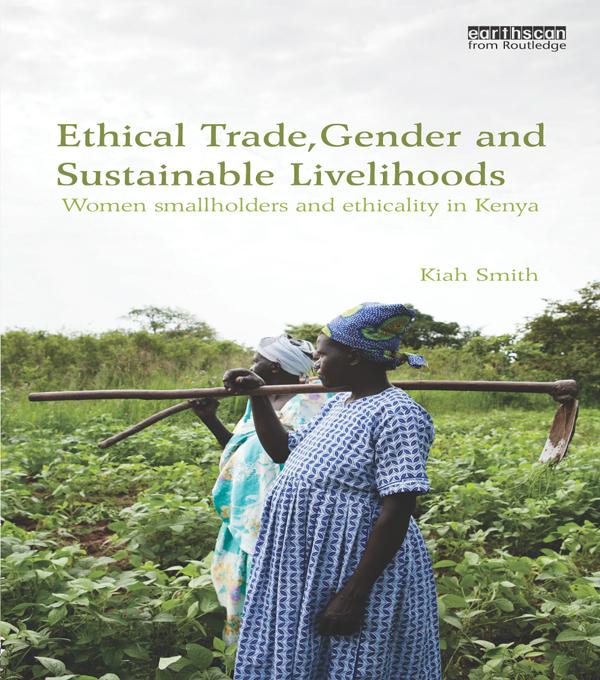
Fair and ethical trade is often criticized for being highly gendered, and for institutionalizing the ethical values of consumers, the priorities of NGOs and governments, and most of all, food retailers. But little is known about how women smallholder farmers experience diverse ethical standards, or whether and how standards reflect their values, local cultural and environmental contexts, or priorities for achieving sustainable livelihoods.
Linking gender, smallholder livelihoods and global ethical trade regulations, this book reveals that multiple understandings of social justice, environmental sustainability and well-being – or ethicality – exist in parallel to those institutionalized in ethical trade schemes. Through an in-depth case study of smallholder subsistence and French bean farming in Kenya, the book grounds the analysis of livelihoods, gender and ethical trade in women smallholders’ perspectives, links the macro level of markets with the micro level of livelihoods, and engenders relations of power, structure and agency in food networks.
It brings together disparate bodies of theory to illustrate the knowledge, strategies and values of women smallholder farmers that are often beyond the scope of ethical trade regulations. It also provides a challenging new vision for doing food systems research.
Płać wygodnie kartą, Klarną, Apple Pay lub Google Pay. Nie jesteś zadowolony? Zawsze masz 14-dniową gwarancję zwrotu pieniędzy. Więcej przeczytasz w naszych warunkach. Masz pytania? Napisz do nas na hello@memmo.org.
Memmo ułatwia naukę – gdziekolwiek jesteś na świecie. U nas znajdziesz podręczniki i sprytne narzędzia do nauki w jednym miejscu: streszczenia, quizy, podcasty i fiszki. A do tego Ted, Twój kumpel do nauki, który odpowie na wszystko, co Cię nurtuje. Ponad 50 000 studentów już tu się uczy – stworzone, byś uczył się szybciej i mniej stresował.