
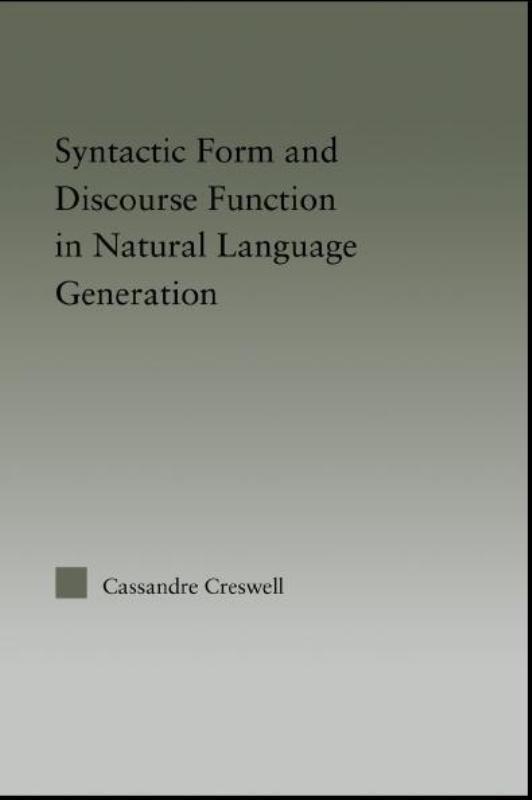
Users of natural languages have many word orders with which to encode the same truth-conditional meaning. They choose contextually appropriate strings from these many ways with little conscious effort and with effective communicative results. Previous computational models of when English speakers produce non-canonical word orders, like topicalization, left-dislocation and clefts, fail. The primary goal of this book is to present a better model of when speakers choose to produce certain non-canonical word orders by incorporating the effects of discourse context and speaker goals on syntactic choice. This book makes extensive use of previously unexamined naturally occurring corpus data of non-canonical word order in English, both to illustrate the points of the theoretical model and to train the statistical model.
Płać wygodnie kartą, Klarną, Apple Pay lub Google Pay. Nie jesteś zadowolony? Zawsze masz 14-dniową gwarancję zwrotu pieniędzy. Więcej przeczytasz w naszych warunkach. Masz pytania? Napisz do nas na hello@memmo.org.
Memmo ułatwia naukę – gdziekolwiek jesteś na świecie. U nas znajdziesz podręczniki i sprytne narzędzia do nauki w jednym miejscu: streszczenia, quizy, podcasty i fiszki. A do tego Ted, Twój kumpel do nauki, który odpowie na wszystko, co Cię nurtuje. Ponad 50 000 studentów już tu się uczy – stworzone, byś uczył się szybciej i mniej stresował.
Może Ci się spodobać
Kup książkę0