
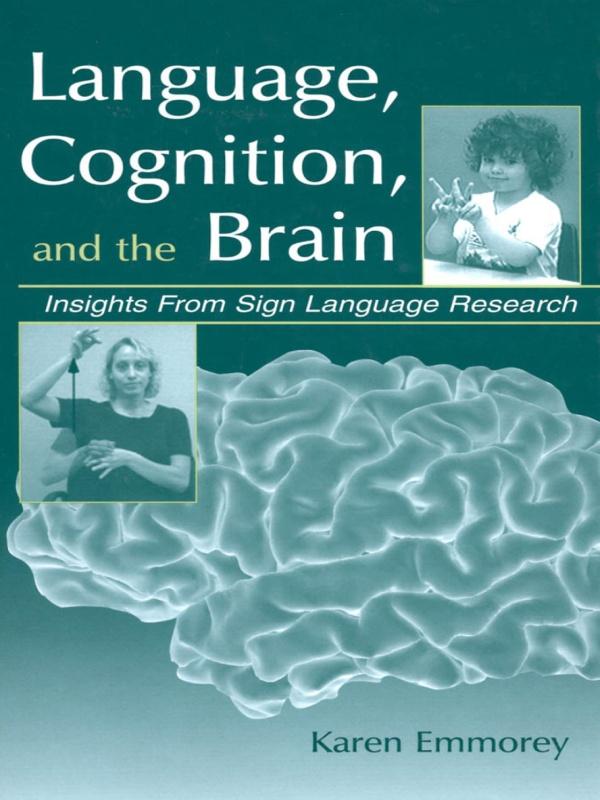
Once signed languages are recognized as natural human languages, a world of exploration opens up. Signed languages provide a powerful tool for investigating the nature of human language and language processing, the relation between cognition and language, and the neural organization of language. The value of sign languages lies in their modality. Specifically, for perception, signed languages depend upon high-level vision and motion processing systems, and for production, they require the integration of motor systems involving the hands and face. These facts raise many questions: What impact does this different biological base have for grammatical systems? For online language processing? For the acquisition of language? How does it affect nonlinguistic cognitive structures and processing? Are the same neural systems involved?
These are some of the questions that this book aims at addressing. The answers provide insight into what constrains grammatical form, language processing, linguistic working memory, and hemispheric specialization for language. The study of signed languages allows researchers to address questions about the nature of linguistic and cognitive systems that otherwise could not be easily addressed.
Płać wygodnie kartą, Klarną, Apple Pay lub Google Pay. Nie jesteś zadowolony? Zawsze masz 14-dniową gwarancję zwrotu pieniędzy. Więcej przeczytasz w naszych warunkach. Masz pytania? Napisz do nas na hello@memmo.org.
Memmo ułatwia naukę – gdziekolwiek jesteś na świecie. U nas znajdziesz podręczniki i sprytne narzędzia do nauki w jednym miejscu: streszczenia, quizy, podcasty i fiszki. A do tego Ted, Twój kumpel do nauki, który odpowie na wszystko, co Cię nurtuje. Ponad 50 000 studentów już tu się uczy – stworzone, byś uczył się szybciej i mniej stresował.