
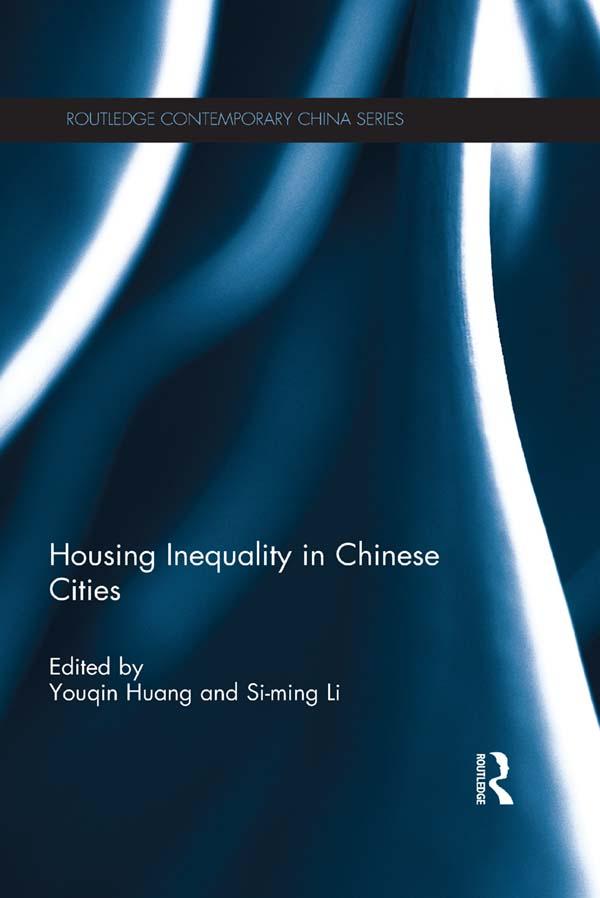
In recent decades, Chinese cities have experienced profound social, economic and spatial transformations. In particular, Chinese cities have witnessed the largest housing boom in history and unprecedented housing privatization. China now is a country of homeowners, with more than 70 per cent of urban residents owning homes, higher than many developed countries.
This book shows how China’s spectacular housing success is not shared by all social groups, with rapidly rising housing inequality, and residential segregation increasingly prevalent in previously homogeneous Chinese cities. It focuses on the two extremes of the residential landscape, and reveals the stark contrast between low-income households who live in shacks in so-called ‘urban villages’ and the nouveaux riches who live in exclusive gated villa communities. Over four parts, the contributors look at the degree to which inequality affects Chinese cities, and the extent of residential differentiation; housing for the urban poor, and in particular, housing for migrants from rural China; housing for the rapidly expanding Chinese middle class and the new rich; and finally, governance in residential neighbourhoods.
Housing Inequality in Chinese Cities presents theoretically informed and empirically grounded research into the polarized residential landscape in Chinese cities, and as such will be of great interest to students and scholars of Chinese studies, urban geography, urban sociology, and urban studies.
Płać wygodnie kartą, Klarną, Apple Pay lub Google Pay. Nie jesteś zadowolony? Zawsze masz 14-dniową gwarancję zwrotu pieniędzy. Więcej przeczytasz w naszych warunkach. Masz pytania? Napisz do nas na hello@memmo.org.
Memmo ułatwia naukę – gdziekolwiek jesteś na świecie. U nas znajdziesz podręczniki i sprytne narzędzia do nauki w jednym miejscu: streszczenia, quizy, podcasty i fiszki. A do tego Ted, Twój kumpel do nauki, który odpowie na wszystko, co Cię nurtuje. Ponad 50 000 studentów już tu się uczy – stworzone, byś uczył się szybciej i mniej stresował.