
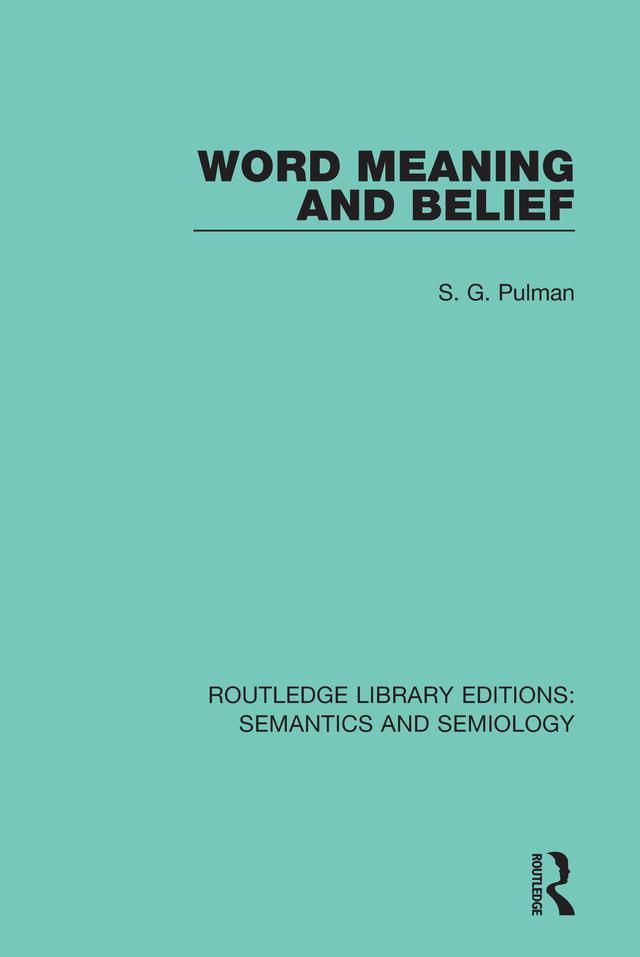
First published in 1983, the aim of this book is to diagnose linguists’ failure to advance satisfactory theories of lexical meaning, then to propose the requirements that such a theory should meet and, drawing on work in philosophy and psychology, to take the first steps towards satisfying these requirements. It begins by discussing the work of Quine on the indeterminacy of translation and it is shown that attempts by linguists to answer Quine’s arguments by proposing universal ‘semantic primitives’ or their equivalents is unsatisfactory. The relation between the theory of word meaning and the theory of categorisation is explored, and an alternative to Rosch’s ‘family resemblance’ account of the ‘prototype’ effect in both nouns and verbs is provided. The author argues that identification of certain implicit categories like ‘action’ and ‘event’ can be related to principles of individuation, and builds on the work of Kripke and Putnam on proper names and natural kind terms. This book will be of interest to students of linguistics and the philosophy of language.
Płać wygodnie kartą, Klarną, Apple Pay lub Google Pay. Nie jesteś zadowolony? Zawsze masz 14-dniową gwarancję zwrotu pieniędzy. Więcej przeczytasz w naszych warunkach. Masz pytania? Napisz do nas na hello@memmo.org.
Memmo ułatwia naukę – gdziekolwiek jesteś na świecie. U nas znajdziesz podręczniki i sprytne narzędzia do nauki w jednym miejscu: streszczenia, quizy, podcasty i fiszki. A do tego Ted, Twój kumpel do nauki, który odpowie na wszystko, co Cię nurtuje. Ponad 50 000 studentów już tu się uczy – stworzone, byś uczył się szybciej i mniej stresował.