
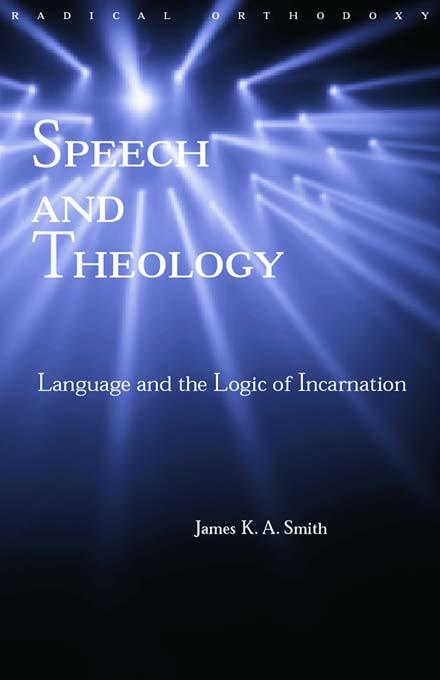
God is infinite, but language finite; thus speech would seem to condemn Him to finitude. In speaking of God, would the theologian violate divine transcendence by reducing God to immanence, or choose, rather, to remain silent? At stake in this argument is a core problem of the conditions of divine revelation. How, in terms of language and the limitations of human understanding, can transcendence ever be made known? Does its very appearance not undermine its transcendence, its condition of unknowability?
Speech and Theology posits that the paradigm for the encounter between the material and the divine, or the immanent and transcendent, is found in the Incarnation: God's voluntary self-immersion in the human world as an expression of His love for His creation. By this key act of grace, hinged upon Christs condescension to human finitude, philosophy acquires the means not simply to speak of perfection, which is to speak theologically, but to bridge the gap between word and thing in general sense.
Płać wygodnie kartą, Klarną, Apple Pay lub Google Pay. Nie jesteś zadowolony? Zawsze masz 14-dniową gwarancję zwrotu pieniędzy. Więcej przeczytasz w naszych warunkach. Masz pytania? Napisz do nas na hello@memmo.org.
Memmo ułatwia naukę – gdziekolwiek jesteś na świecie. U nas znajdziesz podręczniki i sprytne narzędzia do nauki w jednym miejscu: streszczenia, quizy, podcasty i fiszki. A do tego Ted, Twój kumpel do nauki, który odpowie na wszystko, co Cię nurtuje. Ponad 50 000 studentów już tu się uczy – stworzone, byś uczył się szybciej i mniej stresował.