
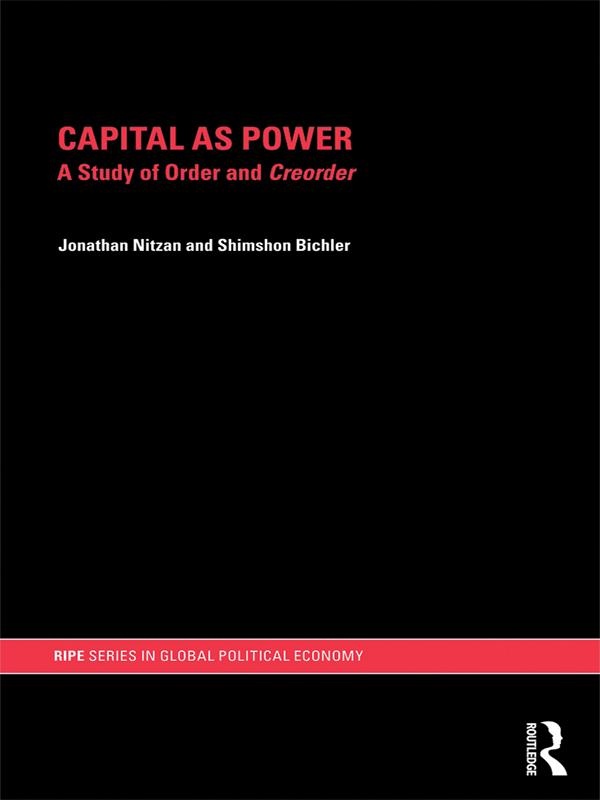
Conventional theories of capitalism are mired in a deep crisis: after centuries of debate, they are still unable to tell us what capital is. Liberals and Marxists both think of capital as an ‘economic’ entity that they count in universal units of ‘utils’ or ‘abstract labour’, respectively. But these units are totally fictitious. Nobody has ever been able to observe or measure them, and for a good reason: they don’t exist. Since liberalism and Marxism depend on these non-existing units, their theories hang in suspension. They cannot explain the process that matters most – the accumulation of capital.
This book offers a radical alternative. According to the authors, capital is not a narrow economic entity, but a symbolic quantification of power. It has little to do with utility or abstract labour, and it extends far beyond machines and production lines. Capital, the authors claim, represents the organized power of dominant capital groups to reshape – or creorder – their society.
Written in simple language, accessible to lay readers and experts alike, the book develops a novel political economy. It takes the reader through the history, assumptions and limitations of mainstream economics and its associated theories of politics. It examines the evolution of Marxist thinking on accumulation and the state. And it articulates an innovative theory of ‘capital as power’ and a new history of the ‘capitalist mode of power’.
Płać wygodnie kartą, Klarną, Apple Pay lub Google Pay. Nie jesteś zadowolony? Zawsze masz 14-dniową gwarancję zwrotu pieniędzy. Więcej przeczytasz w naszych warunkach. Masz pytania? Napisz do nas na hello@memmo.org.
Memmo ułatwia naukę – gdziekolwiek jesteś na świecie. U nas znajdziesz podręczniki i sprytne narzędzia do nauki w jednym miejscu: streszczenia, quizy, podcasty i fiszki. A do tego Ted, Twój kumpel do nauki, który odpowie na wszystko, co Cię nurtuje. Ponad 50 000 studentów już tu się uczy – stworzone, byś uczył się szybciej i mniej stresował.