
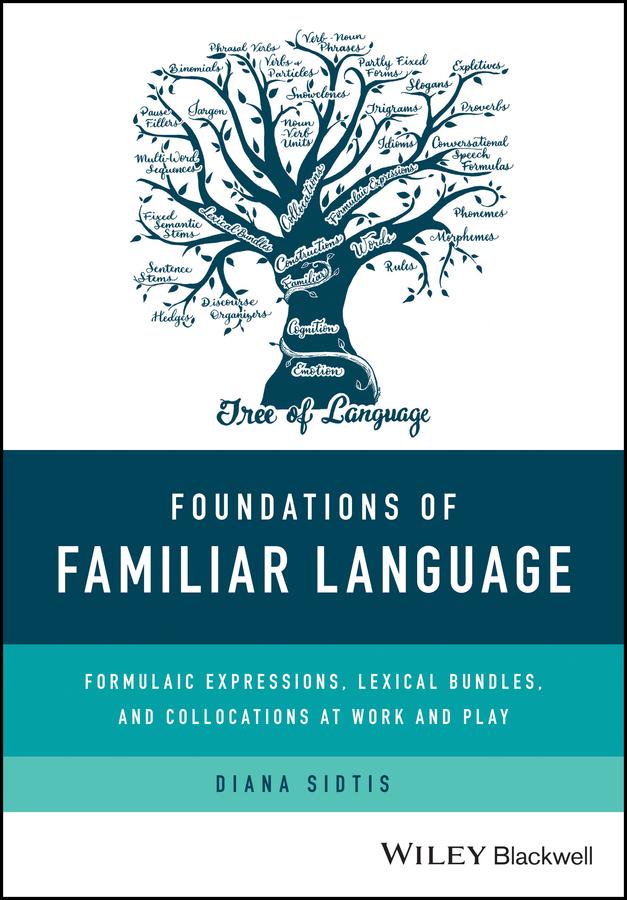
A broad overview of the many kinds of unitary expressions found in everyday verbal and written communication, including their signature meaning, form, and usage, authored by a renowned scholar in the field
Foundations of Familiar Language is renowned scholar Diana Sidtis's new contribution to the study of formulaic language through a wide-ranging overview of a large group of language behaviors that share characteristics of cohesion and familiarity, featuring a rational classification of fixed, familiar expressions into formulaic expressions, lexical bundles, and collocations. This unique volume offers a new approach to linguistic classification and construction grammar through a dual-process model of language competence rooted in linguistic, psycholinguistic, and neurolinguistic observations, combining insights drawn from foundational studies of psychology and neurology with contemporary theories of the differences between formulaic and propositional language. This approach offers a distinct and innovative contribution to scholarship in the field. The text contains resources for further study and research such as examples, research protocols, and lists of fixed, familiar expressions from the past and present. This authoritative volume:
- Describes the current state of knowledge and reviews experimental results, proposals, and models in a clear and straightforward manner
- Offers up-to-date surveys of the role of fixed expressions in education, social sciences, cognitive psychology, and brain science
- Features a wealth of engaging and relatable examples of formulaic expressions (conversational speech formulas, expletives, idioms, and proverbs), lexical bundles, and collocations
- Includes discussion of the use of fixed, familiar expressions in second language learning
- Presents new research data on the neurological foundations of familiar language drawn from clinical observations and experimental studies of stroke, dementia, and Parkinson’s disease
- Contains material from social media, magazines, newspapers, speeches, and other sources to illustrate the importance, abundance, and value of familiar language
Sufficiently in-depth for specialists, while accessible to students and non-specialists, Foundations of Familiar Language is an essential resource for a wide range of readers, including linguists, child language specialists, psychologists, social scientists, neuroscientists, philosophers, educators, teachers of English as a second language, and those working in artificial intelligence and speech synthesis.
Płać wygodnie kartą, Klarną, Apple Pay lub Google Pay. Nie jesteś zadowolony? Zawsze masz 14-dniową gwarancję zwrotu pieniędzy. Więcej przeczytasz w naszych warunkach. Masz pytania? Napisz do nas na hello@memmo.org.
Memmo ułatwia naukę – gdziekolwiek jesteś na świecie. U nas znajdziesz podręczniki i sprytne narzędzia do nauki w jednym miejscu: streszczenia, quizy, podcasty i fiszki. A do tego Ted, Twój kumpel do nauki, który odpowie na wszystko, co Cię nurtuje. Ponad 50 000 studentów już tu się uczy – stworzone, byś uczył się szybciej i mniej stresował.