
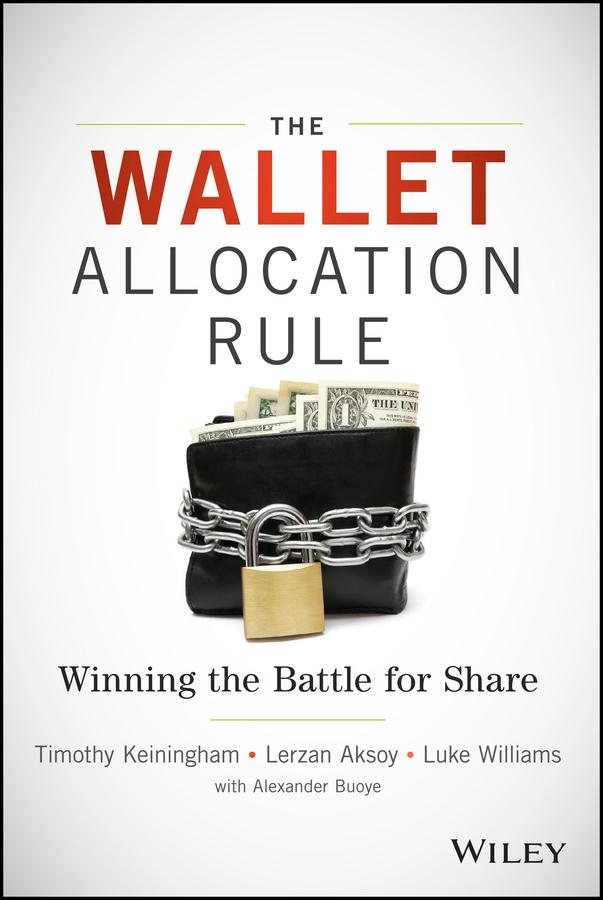
The Wallet Allocation Rule is a revolutionary, definitive guide for winning the battle for share of customers' hearts, minds, and wallets. Backed by rock-solid science published in the Harvard Business Review and MIT Sloan Management Review, this landmark book introduces a new and rigorously tested approach—the Wallet Allocation Rule—that is proven to link to the most important measure of customer loyalty: share of wallet.
Companies currently spend billions of dollars each year measuring and managing metrics like customer satisfaction and Net Promoter Score (NPS) to improve customer loyalty. These metrics, however, have almost no correlation to share of wallet. As a result, the returns on investments designed to improve the customer experience are frequently near zero, even negative.
With The Wallet Allocation Rule, managers finally have the missing link to business growth within their grasp—the ability to link their existing metrics to the share of spending that customers allocate to their brands.
- Learn why improving satisfaction (or NPS) does not improve share.
- Apply the Wallet Allocation Rule to discover what really drives customer spending.
- Uncover new metrics that really matter to achieve growth.
By applying the Wallet Allocation Rule, managers get real insight into the money they currently get from their customers, the money available to be earned by them, and what it takes to get it. The Wallet Allocation Rule provides managers with a blueprint for sustainable long-term growth.
Płać wygodnie kartą, Klarną, Apple Pay lub Google Pay. Nie jesteś zadowolony? Zawsze masz 14-dniową gwarancję zwrotu pieniędzy. Więcej przeczytasz w naszych warunkach. Masz pytania? Napisz do nas na hello@memmo.org.
Memmo ułatwia naukę – gdziekolwiek jesteś na świecie. U nas znajdziesz podręczniki i sprytne narzędzia do nauki w jednym miejscu: streszczenia, quizy, podcasty i fiszki. A do tego Ted, Twój kumpel do nauki, który odpowie na wszystko, co Cię nurtuje. Ponad 50 000 studentów już tu się uczy – stworzone, byś uczył się szybciej i mniej stresował.