
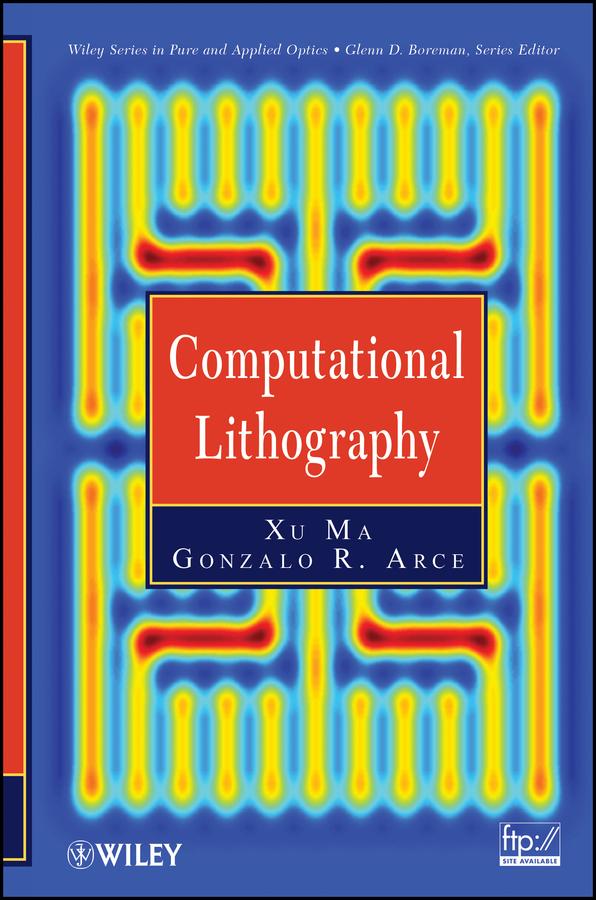
Optical lithography is one of the most challenging areas of current integrated circuit manufacturing technology. The semiconductor industry is relying more on resolution enhancement techniques (RETs), since their implementation does not require significant changes in fabrication infrastructure. Computational Lithography is the first book to address the computational optimization of RETs in optical lithography, providing an in-depth discussion of optimal optical proximity correction (OPC), phase shifting mask (PSM), and off-axis illumination (OAI) RET tools that use model-based mathematical optimization approaches.
The book starts with an introduction to optical lithography systems, electric magnetic field principles, and the fundamentals of optimization from a mathematical point of view. It goes on to describe in detail different types of optimization algorithms to implement RETs. Most of the algorithms developed are based on the application of the OPC, PSM, and OAI approaches and their combinations. Algorithms for coherent illumination as well as partially coherent illumination systems are described, and numerous simulations are offered to illustrate the effectiveness of the algorithms. In addition, mathematical derivations of all optimization frameworks are presented.
The accompanying MATLAB® software files for all the RET methods described in the book make it easy for readers to run and investigate the codes in order to understand and apply the optimization algorithms, as well as to design a set of optimal lithography masks. The codes may also be used by readers for their research and development activities in their academic or industrial organizations. An accompanying MATLAB® software guide is also included. An accompanying MATLAB® software guide is included, and readers can download the software to use with the guide at ftp://ftp.wiley.com/public/sci_tech_med/computational_lithography.
Tailored for both entry-level and experienced readers, Computational Lithography is meant for faculty, graduate students, and researchers, as well as scientists and engineers in industrial organizations whose research or career field is semiconductor IC fabrication, optical lithography, and RETs. Computational lithography draws from the rich theory of inverse problems, optics, optimization, and computational imaging; as such, the book is also directed to researchers and practitioners in these fields.
Płać wygodnie kartą, Klarną, Apple Pay lub Google Pay. Nie jesteś zadowolony? Zawsze masz 14-dniową gwarancję zwrotu pieniędzy. Więcej przeczytasz w naszych warunkach. Masz pytania? Napisz do nas na hello@memmo.org.
Memmo ułatwia naukę – gdziekolwiek jesteś na świecie. U nas znajdziesz podręczniki i sprytne narzędzia do nauki w jednym miejscu: streszczenia, quizy, podcasty i fiszki. A do tego Ted, Twój kumpel do nauki, który odpowie na wszystko, co Cię nurtuje. Ponad 50 000 studentów już tu się uczy – stworzone, byś uczył się szybciej i mniej stresował.