
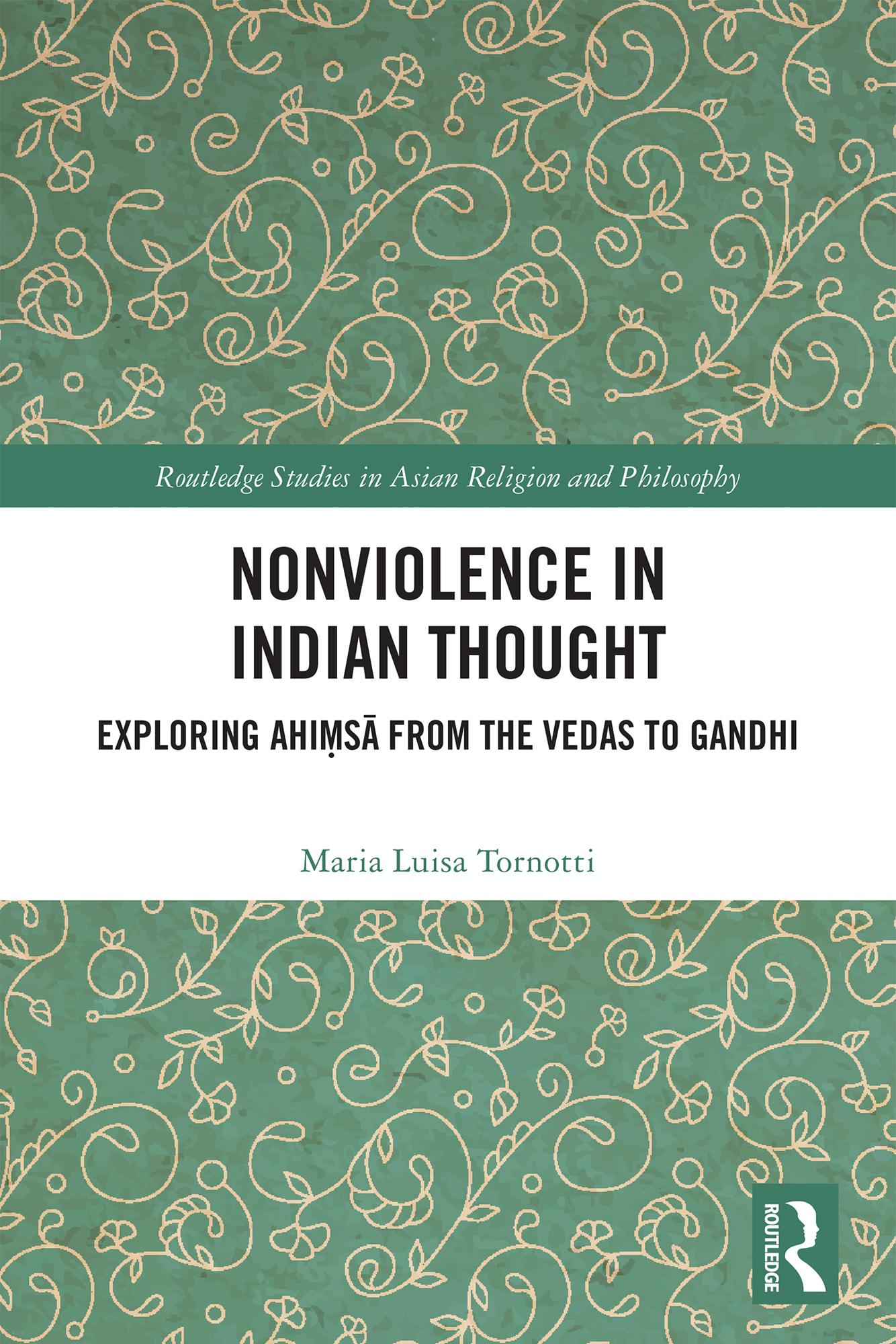
Building on the previous Italian edition, this volume presents a historical narrative and examination of the concept of ahiṃsā (nonviolence) throughout Indian religious and philosophical traditions, tracing its evolution from ancient Vedic texts to Mahatma Gandhi’s modern interpretation and application.
Acknowledging the nuances of the concept of ahiṃsā, the book makes clear that nonviolence in most of the Indic religions is located within a cluster of concepts. Taking a broadly historical and chronological approach, chapters explore the perceptions and understandings of ahiṃsā through the ancient foundational Sanskrit texts of the Vedas and Upanishads, the Hindu texts of the Dharmasutras and Mahabharata, and finally through heterodox traditional texts of Jainism and Buddhism. The book then looks at Gandhi’s comprehensive approach to ahiṃsā, demonstrating that ahiṃsā in Indian thought is not merely passive nonviolence but an active, creative principle.
Ultimately arguing that nonviolence is central to Indian spirituality, around which other ideas can be perceived as responses to this key, guiding principle, this book will be of interest to scholars, researchers and postgraduates in the fields of scriptures of Hinduism, Jainism, Buddhism, and Indian philosophy, religious studies, religion and violence, and peace studies. This book will be also useful to the general reader.
Płać wygodnie kartą, Klarną, Apple Pay lub Google Pay. Nie jesteś zadowolony? Zawsze masz 14-dniową gwarancję zwrotu pieniędzy. Więcej przeczytasz w naszych warunkach. Masz pytania? Napisz do nas na hello@memmo.org.
Memmo ułatwia naukę – gdziekolwiek jesteś na świecie. U nas znajdziesz podręczniki i sprytne narzędzia do nauki w jednym miejscu: streszczenia, quizy, podcasty i fiszki. A do tego Ted, Twój kumpel do nauki, który odpowie na wszystko, co Cię nurtuje. Ponad 50 000 studentów już tu się uczy – stworzone, byś uczył się szybciej i mniej stresował.