
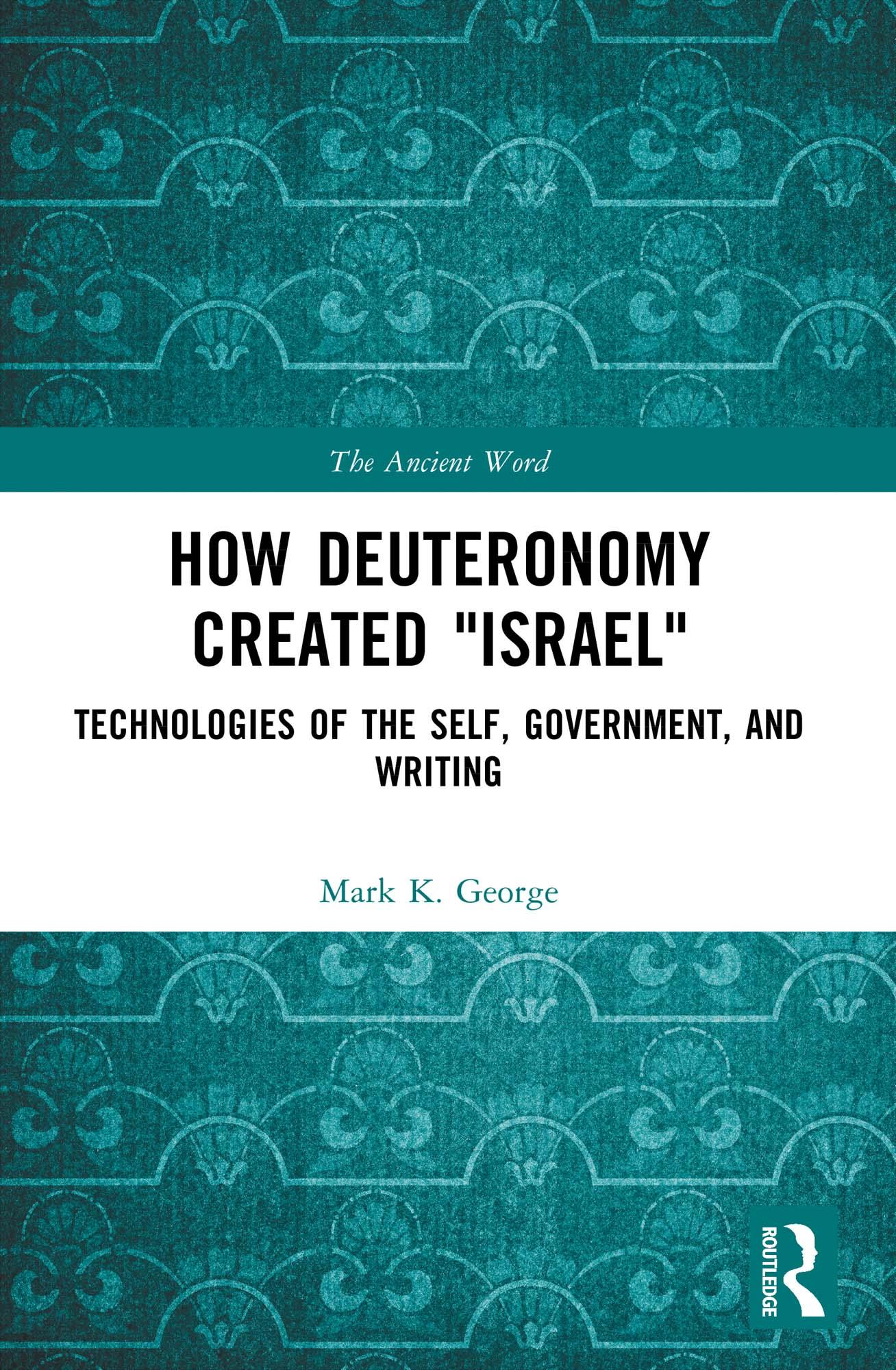
In this book, Mark K. George argues that the goal of Deuteronomy is not merely to provide ancient Judah with another set of laws but to write “Israel” itself into existence. He reads Deuteronomy as a manual for self‑definition with two key aspects: being an Israelite means recognizing oneself as a subject under Yahweh’s control, and Deuteronomy is the handbook of techniques by which one monitors oneself to become Israel.
Scholars have acknowledged the influence of certain literary features of ancient Assyrian imperial treaties on Deuteronomy. In this book, George argues that the key to both Deuteronomy and Assyrian rituals of control is their monitoring mechanism, not only speaking to their audiences but also providing them with new ways to understand themselves and behave. He suggests that Deuteronomy redefines not only Israel but also Yahweh himself according to an Assyrian imperial model—with Israel as the subject, God as a distant imperial ruler, and the text itself as a local monitor. In showing this, he extends the insights of Michel Foucault, who urged us to view power not merely as something imposed from above by force, but as something that can entwine and shape us from below.
This book provides an invaluable exploration of Deuteronomy, of interest to scholars and students working on Deuteronomy itself and biblical studies more generally, as well as on questions of ancient politics and governmentality, Foucault studies, and the history and material culture of the Ancient Near East.
Płać wygodnie kartą, Klarną, Apple Pay lub Google Pay. Nie jesteś zadowolony? Zawsze masz 14-dniową gwarancję zwrotu pieniędzy. Więcej przeczytasz w naszych warunkach. Masz pytania? Napisz do nas na hello@memmo.org.
Memmo ułatwia naukę – gdziekolwiek jesteś na świecie. U nas znajdziesz podręczniki i sprytne narzędzia do nauki w jednym miejscu: streszczenia, quizy, podcasty i fiszki. A do tego Ted, Twój kumpel do nauki, który odpowie na wszystko, co Cię nurtuje. Ponad 50 000 studentów już tu się uczy – stworzone, byś uczył się szybciej i mniej stresował.