
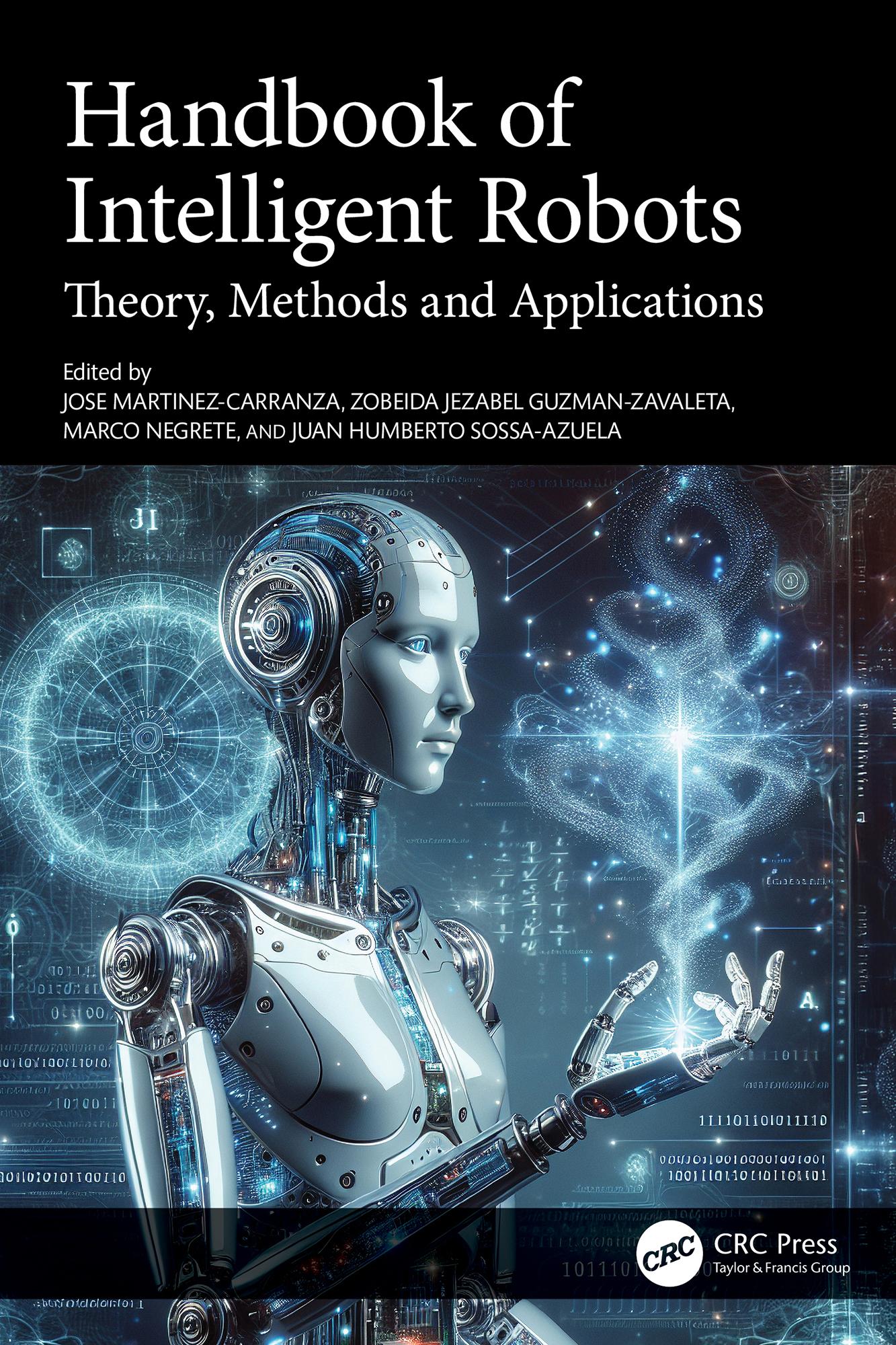
This handbook introduces some of the most relevant techniques used to develop intelligent robotic systems and provides several examples of applications where robots equipped with AI are deployed to solve a task.
Handbook of Intelligent Robots: Theory, Methods and Applications is split into two main parts. The first part reviews key methods for developing intelligent robots implemented across various robotic systems, including service robots, micro aerial vehicles, manipulators, and humanoids, among others, deployed in diverse applications. The second part of the book provides several examples of applications where robotics systems are leveraged by AI and machine learning techniques to address real life applications, thus providing insights into the challenges and limitations of deploying robotic systems outside the laboratory. The main goal of the book is to familiarize the reader with the most recent concepts and techniques that are enabling robots to update their learned models online, to perform them efficiently on embedded processors, and to enable sophisticated interaction with the environment using spatial AI techniques such as visual simultaneous localization and mapping. To this end, the reader will delve into techniques such as continual learning, binary neural networks, neural controllers, fuzzy controllers, generation of time-optimal trajectories, generative models, natural language processing for robotics, and robot audition.
This book is intended for electrical, computer and mechanical engineers interested in robotics and AI as well as those interested in robots deployed in real life scenarios. It will be useful to postgraduate students seeking reviews of the state of the art regarding AI methods for robotics such as visual SLAM, continual learning, neural networks, and transformers.
Płać wygodnie kartą, Klarną, Apple Pay lub Google Pay. Nie jesteś zadowolony? Zawsze masz 14-dniową gwarancję zwrotu pieniędzy. Więcej przeczytasz w naszych warunkach. Masz pytania? Napisz do nas na hello@memmo.org.
Memmo ułatwia naukę – gdziekolwiek jesteś na świecie. U nas znajdziesz podręczniki i sprytne narzędzia do nauki w jednym miejscu: streszczenia, quizy, podcasty i fiszki. A do tego Ted, Twój kumpel do nauki, który odpowie na wszystko, co Cię nurtuje. Ponad 50 000 studentów już tu się uczy – stworzone, byś uczył się szybciej i mniej stresował.