
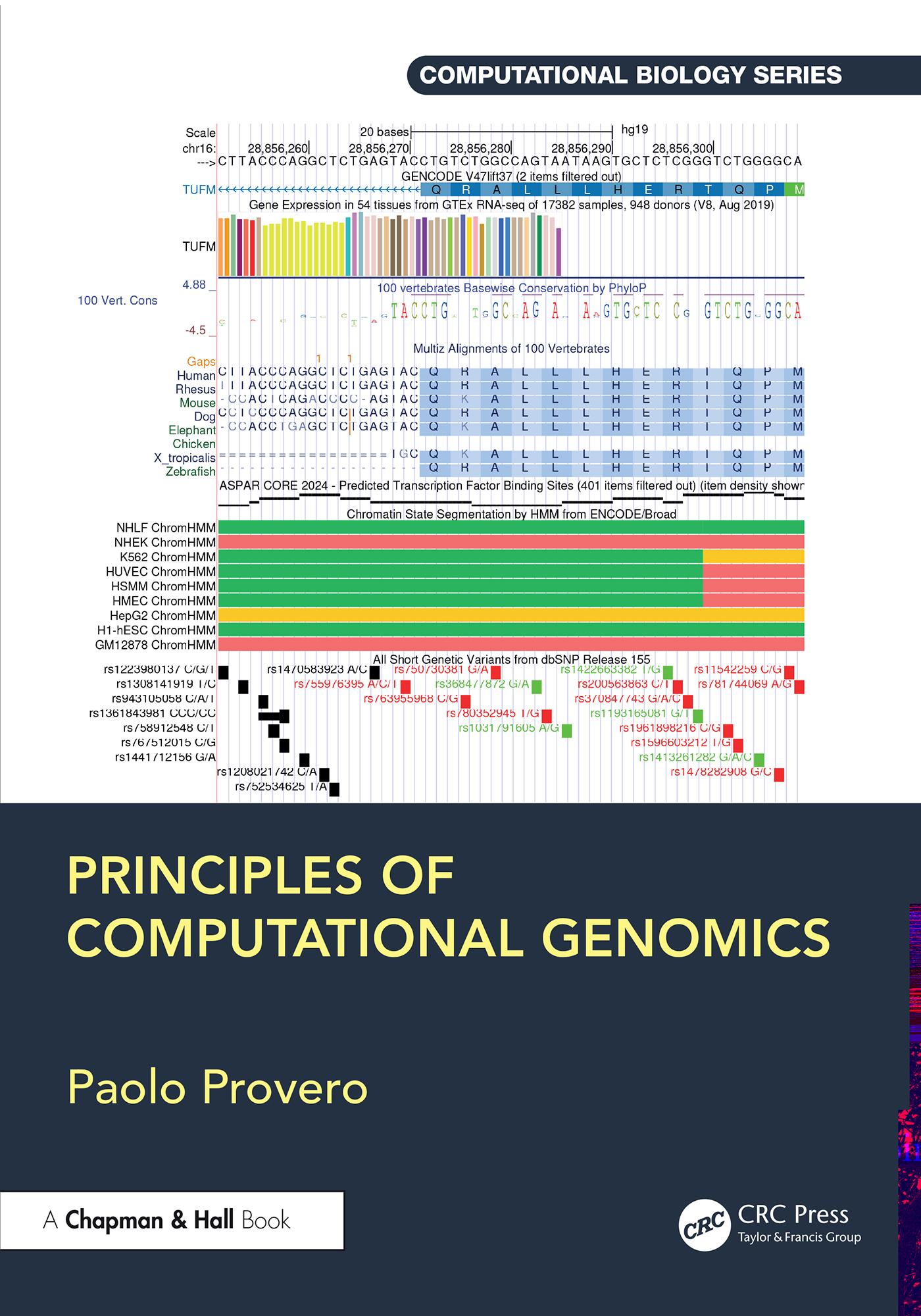
The advent of high-throughput experimental assays, and in particular of next-generation sequencing, has revolutionized life sciences by enabling the generation of data at the scale of the whole genome. Extracting biologically useful or clinically actionable information from this data requires analytical methods quite different from the ones used to analyze low-throughput experimental results. The development of these methods is the goal of computational biology.
Understanding the principles on which these methods are based is thus necessary for all students and researchers in life sciences. This book provides the conceptual framework needed to understand computational genomics enough to be able to follow the arguments in recent papers, or to collaborate with computational scientists in research projects. In particular, it introduces the mathematical and statistical basis of the methods in some depth. The main focus is on the analysis of next-generation-sequencing assays, both for the interpretation of the DNA sequence per se (sequence alignment, phylogenetic tree reconstruction, genetic variants) and for the study of gene regulation and epigenomics (gene expression, transcription factor binding, chromatin states, 3D structure of the genome). The final chapter discusses the associations of genetic variants with phenotypes and diseases, and their biological interpretation.
Principles of Computational Genomics provides a solid foundation for understanding the many parts of computational genomics, including those not treated directly in the book. It will be of great benefit to students and researchers across the life sciences.
Płać wygodnie kartą, Klarną, Apple Pay lub Google Pay. Nie jesteś zadowolony? Zawsze masz 14-dniową gwarancję zwrotu pieniędzy. Więcej przeczytasz w naszych warunkach. Masz pytania? Napisz do nas na hello@memmo.org.
Memmo ułatwia naukę – gdziekolwiek jesteś na świecie. U nas znajdziesz podręczniki i sprytne narzędzia do nauki w jednym miejscu: streszczenia, quizy, podcasty i fiszki. A do tego Ted, Twój kumpel do nauki, który odpowie na wszystko, co Cię nurtuje. Ponad 50 000 studentów już tu się uczy – stworzone, byś uczył się szybciej i mniej stresował.