
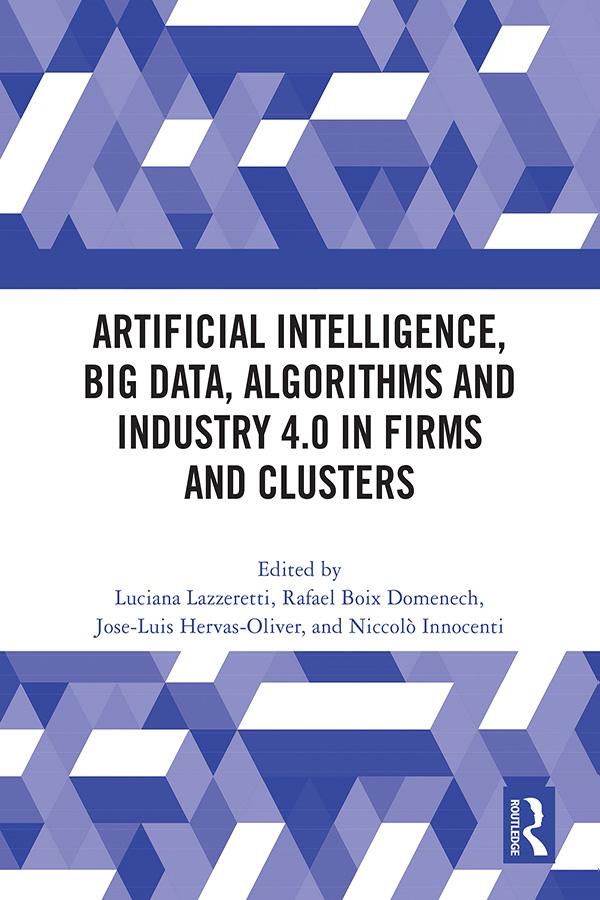
This volume offers a wide-ranging discussion on the interrelations among AI, algorithms, big data, and Industry 4.0 to understand the importance of these new paradigms for the development of firms, districts, clusters, cities, regions, and innovation.
Drawing on theoretical, empirical, and qualitative studies and using local perspectives, the chapters in this book explore theoretical aspects of AI and its evolution in social sciences, focusing on industry 4.0, smart cities, big data, and other related topics. They examine the role of industrial robots in employment, productivity, and knowledge absorption in industrial districts. They also discuss innovation in the context of local production systems, AI ecosystems, and the growth and potential of the Metaverse. Taken together, the book offers insights to help understand the new dynamics generated by the advent of these technologies and how they may affect regions, cities, clusters, industries, and organizations, and identifies avenues for future research in the development of new trajectories for clusters and firms.
This book will be a key resource for scholars and advanced students in the fields of economics, geography, architecture, planning, and management as well as for interdisciplinary researchers who want to learn more about the development of new technologies, the relevance of AI, Big Data and I4.0 for firms and in relation to their adoption in clusters. This book was originally published as a special issue of European Planning Studies.
Płać wygodnie kartą, Klarną, Apple Pay lub Google Pay. Nie jesteś zadowolony? Zawsze masz 14-dniową gwarancję zwrotu pieniędzy. Więcej przeczytasz w naszych warunkach. Masz pytania? Napisz do nas na hello@memmo.org.
Memmo ułatwia naukę – gdziekolwiek jesteś na świecie. U nas znajdziesz podręczniki i sprytne narzędzia do nauki w jednym miejscu: streszczenia, quizy, podcasty i fiszki. A do tego Ted, Twój kumpel do nauki, który odpowie na wszystko, co Cię nurtuje. Ponad 50 000 studentów już tu się uczy – stworzone, byś uczył się szybciej i mniej stresował.