
“Our community has continued to grow exponentially, thanks to those who inspire the next generation. And inspiring the next generation is what the authors of Analyzing Baseball Data with R are doing. They are setting the career path for still thousands more. We all need some sort of kickstart to take that first or second step. You may be a beginner R coder, but you need access to baseball data. How do you access this data, how do you manipulate it, how do you analyze it? This is what this book does for you. But it does more, by doing what sabermetrics does best: it asks baseball questions. Throughout the book, baseball questions are asked, some straightforward, and others more thought-provoking.”
From the Foreword by Tom Tango
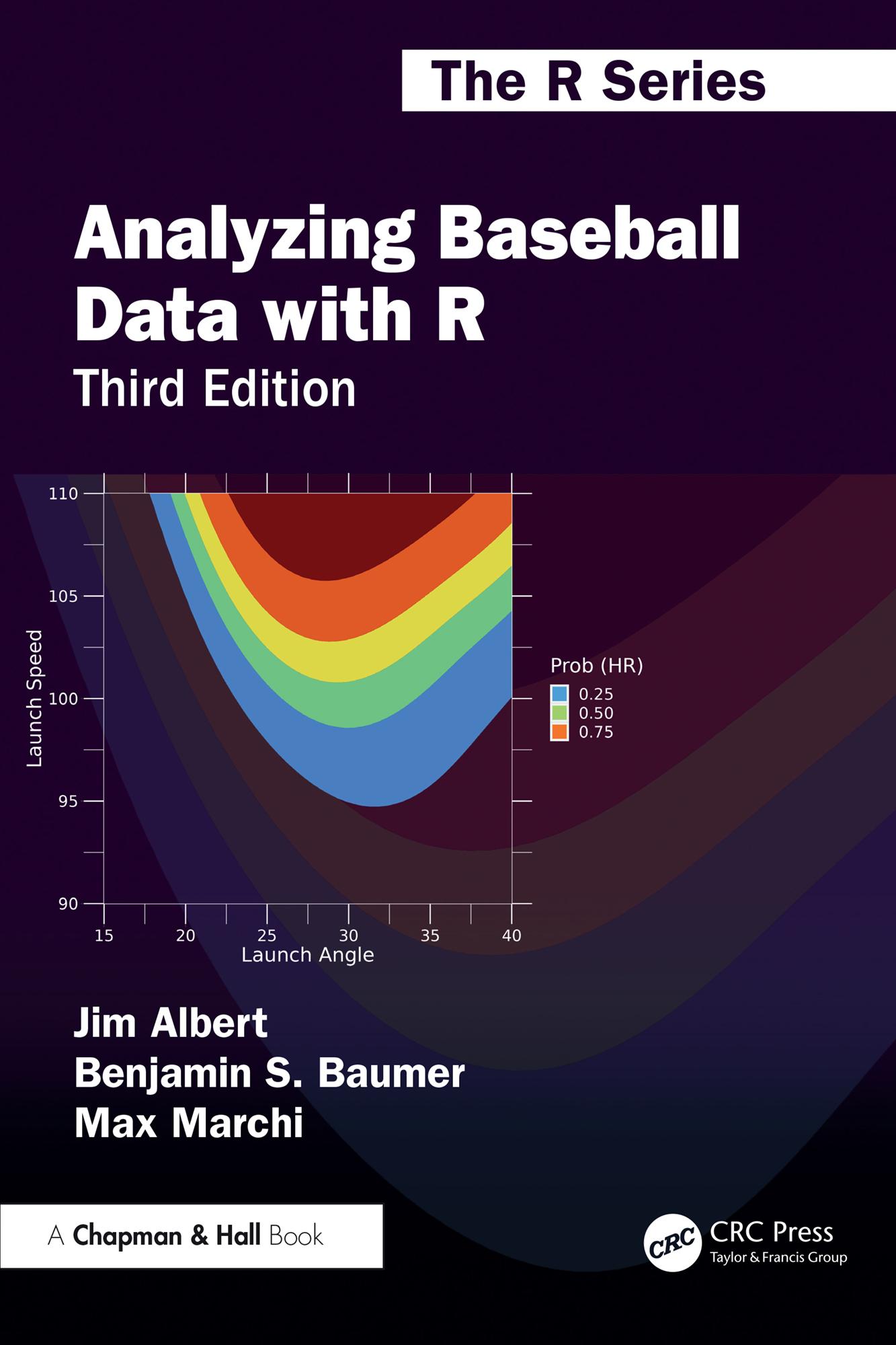
Analyzing Baseball Data with R Third Edition introduces R to sabermetricians, baseball enthusiasts, and students interested in exploring the richness of baseball data. It equips you with the necessary skills and software tools to perform all the analysis steps, from importing the data to transforming them into an appropriate format to visualizing the data via graphs to performing a statistical analysis.
The authors first present an overview of publicly available baseball datasets and a gentle introduction to the type of data structures and exploratory and data management capabilities of R. They also cover the ggplot2 graphics functions and employ a tidyverse-friendly workflow throughout. Much of the book illustrates the use of R through popular sabermetrics topics, including the Pythagorean formula, runs expectancy, catcher framing, career trajectories, simulation of games and seasons, patterns of streaky behavior of players, and launch angles and exit velocities. All the datasets and R code used in the text are available for download online.
New to the third edition is the revised R code to make use of new functions made available through the tidyverse. The third edition introduces three chapters of new material, focusing on communicating results via presentations using the Quarto publishing system, web applications using the Shiny package, and working with large data files. An online version of this book is hosted at https://beanumber.github.io/abdwr3e/.
Płać wygodnie kartą, Klarną, Apple Pay lub Google Pay. Nie jesteś zadowolony? Zawsze masz 14-dniową gwarancję zwrotu pieniędzy. Więcej przeczytasz w naszych warunkach. Masz pytania? Napisz do nas na hello@memmo.org.
Memmo ułatwia naukę – gdziekolwiek jesteś na świecie. U nas znajdziesz podręczniki i sprytne narzędzia do nauki w jednym miejscu: streszczenia, quizy, podcasty i fiszki. A do tego Ted, Twój kumpel do nauki, który odpowie na wszystko, co Cię nurtuje. Ponad 50 000 studentów już tu się uczy – stworzone, byś uczył się szybciej i mniej stresował.