
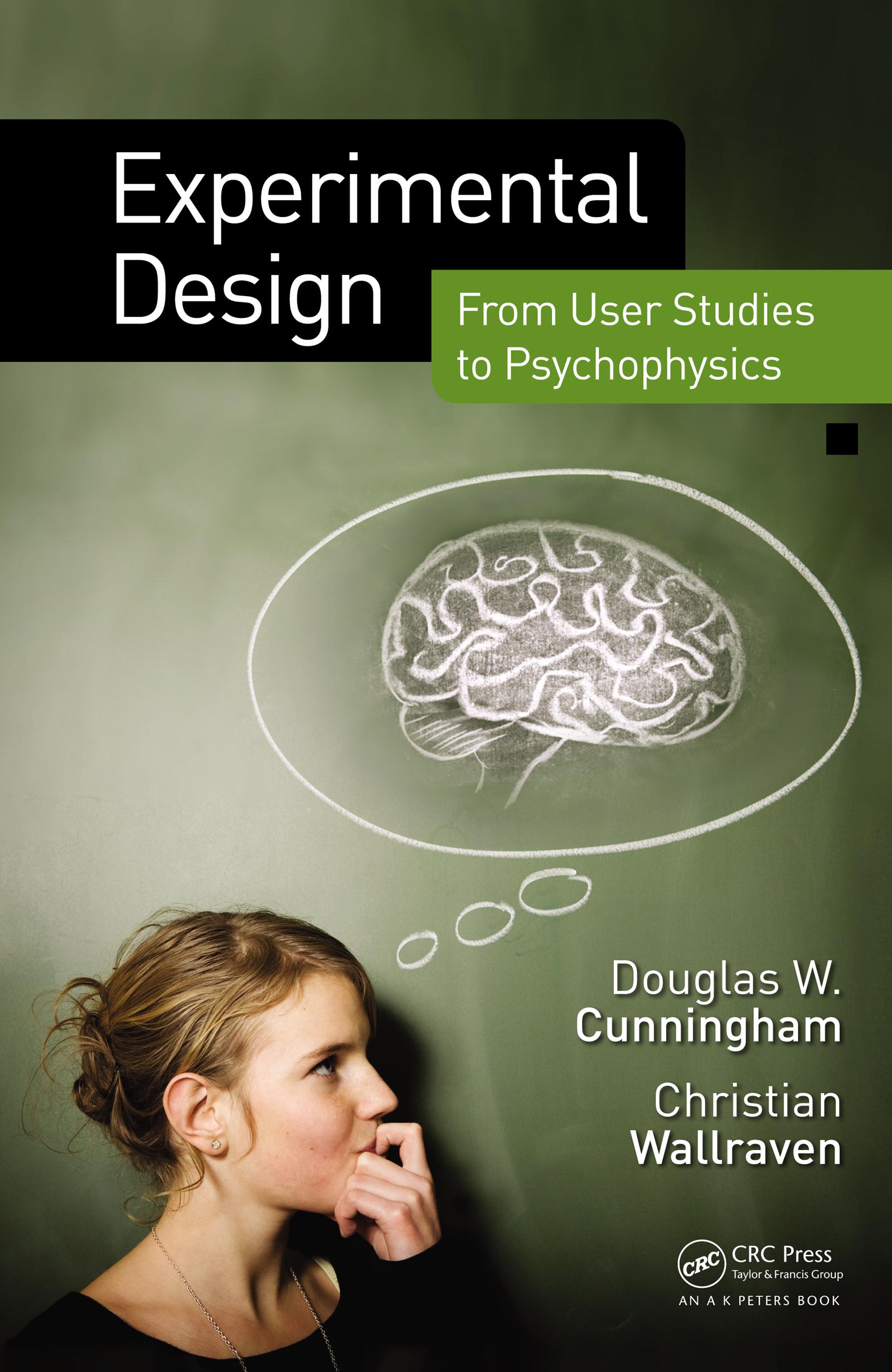
As computers proliferate and as the field of computer graphics matures, it has become increasingly important for computer scientists to understand how users perceive and interpret computer graphics. Experimental Design: From User Studies to Psychophysics is an accessible introduction to psychological experiments and experimental design, covering the major components in the design, execution, and analysis of perceptual studies.
The book begins with an introduction to the concepts central to designing and understanding experiments, including developing a research question, setting conditions and controls, and balancing specificity with generality. The book then explores in detail a number of types of experimental tasks: free description, rating scales, forced-choice, specialized multiple choice, and real-world tasks as well as physiological studies. It discusses the advantages and disadvantages of each type and provides examples of that type of experiment from the authors’ own work. The book also covers stimulus-related issues, including popular stimulus resources. It concludes with a thorough examination of statistical techniques for analyzing results, including methods specific to individual tasks.
Płać wygodnie kartą, Klarną, Apple Pay lub Google Pay. Nie jesteś zadowolony? Zawsze masz 14-dniową gwarancję zwrotu pieniędzy. Więcej przeczytasz w naszych warunkach. Masz pytania? Napisz do nas na hello@memmo.org.
Memmo ułatwia naukę – gdziekolwiek jesteś na świecie. U nas znajdziesz podręczniki i sprytne narzędzia do nauki w jednym miejscu: streszczenia, quizy, podcasty i fiszki. A do tego Ted, Twój kumpel do nauki, który odpowie na wszystko, co Cię nurtuje. Ponad 50 000 studentów już tu się uczy – stworzone, byś uczył się szybciej i mniej stresował.