
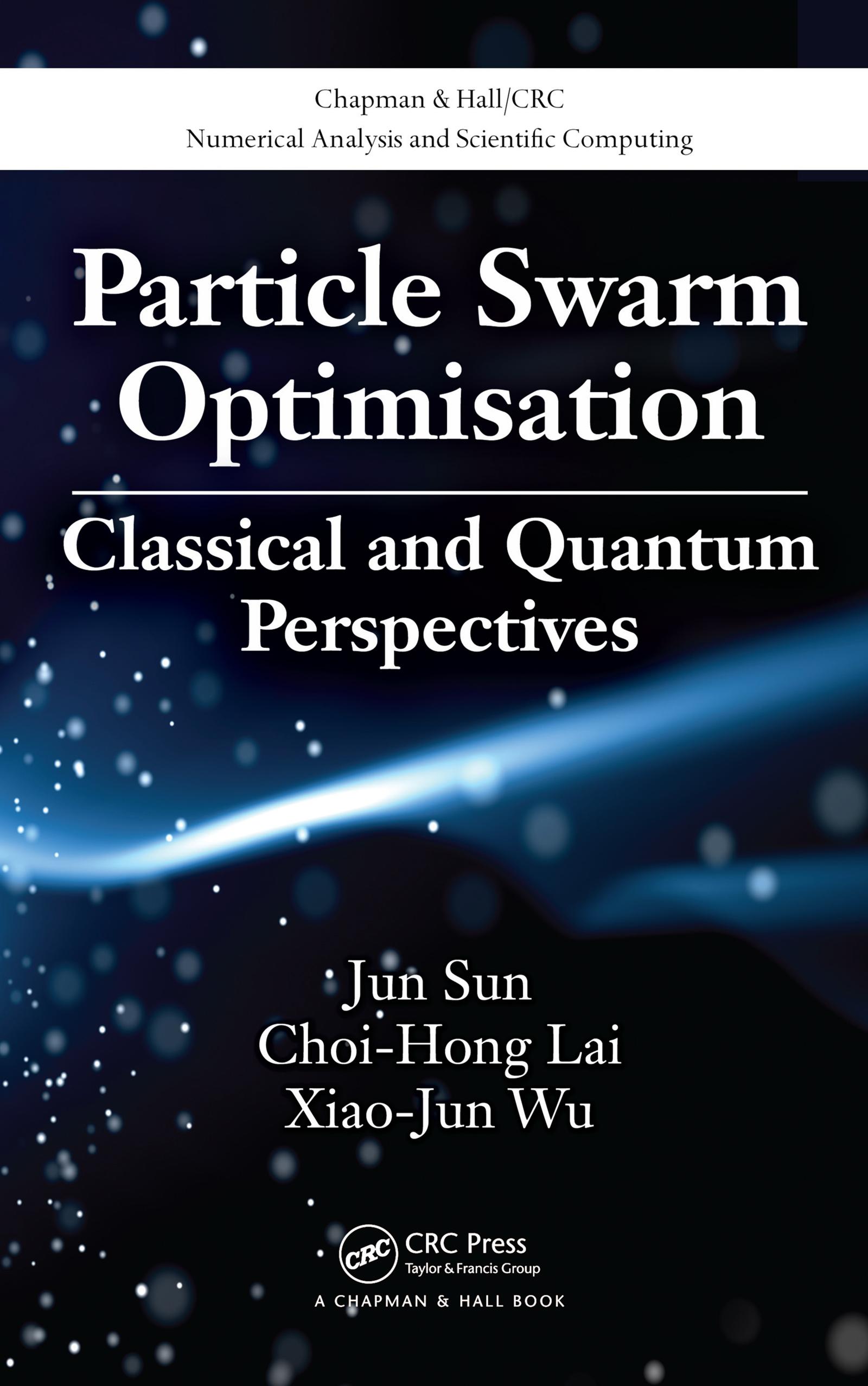
Although the particle swarm optimisation (PSO) algorithm requires relatively few parameters and is computationally simple and easy to implement, it is not a globally convergent algorithm. In Particle Swarm Optimisation: Classical and Quantum Perspectives, the authors introduce their concept of quantum-behaved particles inspired by quantum mechanics, which leads to the quantum-behaved particle swarm optimisation (QPSO) algorithm. This globally convergent algorithm has fewer parameters, a faster convergence rate, and stronger searchability for complex problems.
The book presents the concepts of optimisation problems as well as random search methods for optimisation before discussing the principles of the PSO algorithm. Examples illustrate how the PSO algorithm solves optimisation problems. The authors also analyse the reasons behind the shortcomings of the PSO algorithm.
Moving on to the QPSO algorithm, the authors give a thorough overview of the literature on QPSO, describe the fundamental model for the QPSO algorithm, and explore applications of the algorithm to solve typical optimisation problems. They also discuss some advanced theoretical topics, including the behaviour of individual particles, global convergence, computational complexity, convergence rate, and parameter selection. The text closes with coverage of several real-world applications, including inverse problems, optimal design of digital filters, economic dispatch problems, biological multiple sequence alignment, and image processing. MATLAB®, Fortran, and C++ source codes for the main algorithms are provided on an accompanying downloadable resources.
Helping you numerically solve optimisation problems, this book focuses on the fundamental principles and applications of PSO and QPSO algorithms. It not only explains how to use the algorithms, but also covers advanced topics that establish the groundwork for understanding.
Płać wygodnie kartą, Klarną, Apple Pay lub Google Pay. Nie jesteś zadowolony? Zawsze masz 14-dniową gwarancję zwrotu pieniędzy. Więcej przeczytasz w naszych warunkach. Masz pytania? Napisz do nas na hello@memmo.org.
Memmo ułatwia naukę – gdziekolwiek jesteś na świecie. U nas znajdziesz podręczniki i sprytne narzędzia do nauki w jednym miejscu: streszczenia, quizy, podcasty i fiszki. A do tego Ted, Twój kumpel do nauki, który odpowie na wszystko, co Cię nurtuje. Ponad 50 000 studentów już tu się uczy – stworzone, byś uczył się szybciej i mniej stresował.