
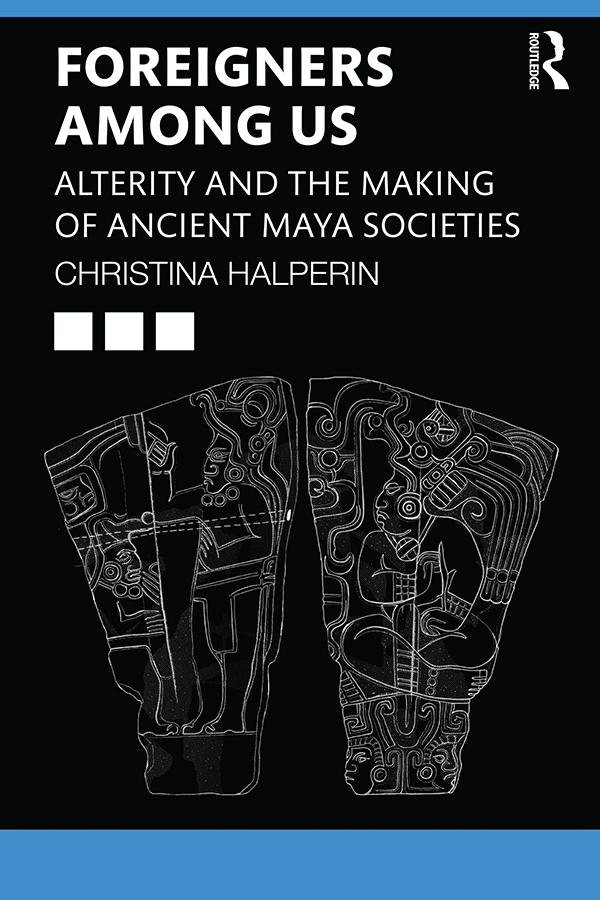
Assessing key questions such as who the foreigners and outsiders in ancient Maya societies were and how was the foreign a generative component of identity, Foreigners Among Us reassess the arrival of foreigners as part of archaeological understandings of Pre-Columbian Maya and questions not only who these foreigners might have been but who were making such designations of difference in the first place.
Drawing from identity studies, standpoint theory, and ideas on alterity, Foreigners Among Us highlights the diverse ways being foreign was constituted, imitated, and marked – from quotidian practices of making corn tortillas to ceremonial acts between king and captive and their memorialization in scenes on sculpted stone monuments. Rather than treat the foreign as axiomatically determined by geographical distance or fixed at birth, the book considers the foreign as much performed as inherited. It examines practices of captivity, cuisine, body ornamentation and dress, diasporic objects, relationships with deities, migration, and pilgrimage. The book focuses, in particular, on diverse peoples in the Maya area during the Classic and Postclassic periods, but also necessarily peers into contacts, engagements and relations throughout Mesoamerica, the Americas more broadly, and with Europeans during the Colonial period – all the while insisting that outsider status must be approached as multi-scalar, relational, and intersectional rather than as neutral, intrinsic, and static.
Contributing broadly to intellectual investigations on foreign identities from an anthropological perspective, this book enriches the understanding of Maya society for students and researchers of Mesoamerican archaeology and art history.
Płać wygodnie kartą, Klarną, Apple Pay lub Google Pay. Nie jesteś zadowolony? Zawsze masz 14-dniową gwarancję zwrotu pieniędzy. Więcej przeczytasz w naszych warunkach. Masz pytania? Napisz do nas na hello@memmo.org.
Memmo ułatwia naukę – gdziekolwiek jesteś na świecie. U nas znajdziesz podręczniki i sprytne narzędzia do nauki w jednym miejscu: streszczenia, quizy, podcasty i fiszki. A do tego Ted, Twój kumpel do nauki, który odpowie na wszystko, co Cię nurtuje. Ponad 50 000 studentów już tu się uczy – stworzone, byś uczył się szybciej i mniej stresował.