
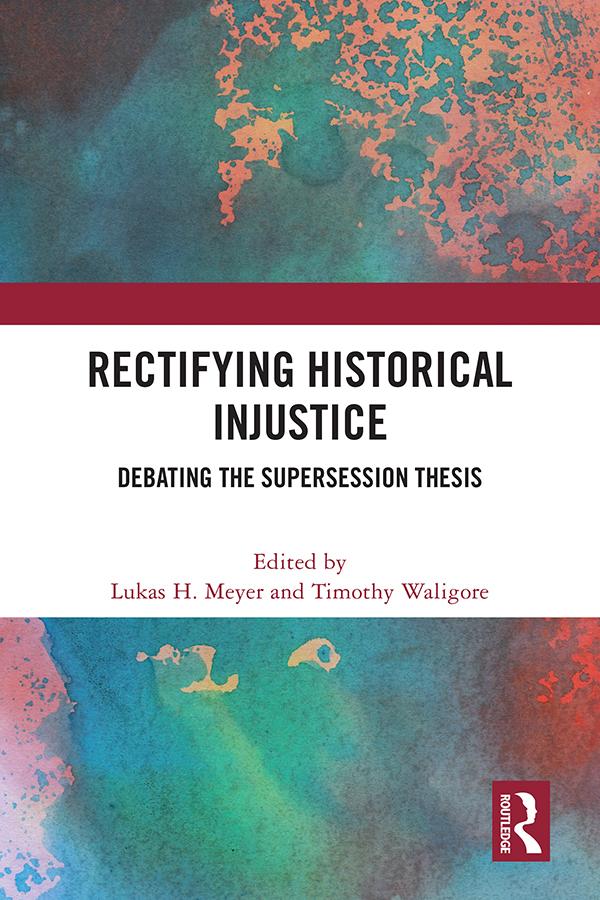
Calls for redress of historical wrongs regularly make headlines around the world. People dispute the degree to which justice should be concerned with righting past wrongs, with some arguing that justice should be primarily focused on claims arising from present disadvantage. Proponents and sceptics of restitution, compensation, and other forms of historical redress have engaged with the thesis that historical injustice can be superseded, the idea that changing circumstances following historical injustices can alter what justice later requires. The “supersession thesis,” developed by legal and political philosopher Jeremy Waldron, has been challenged, both conceptually and in terms of its possible application and implications.
This is the first book to critically assess how the supersession thesis might be reconstructed, challenged, or applied to empirical cases, with an eye toward larger questions surrounding the temporal orientation of justice. Cases examined include Indigenous peoples, linguistic injustice, and climate change. The edited volume includes contributions by established and junior scholars from philosophy, law, American Indian Studies, and political science, who draw from Indigenous thought, settler colonial theory, liberalism, theories of historical entitlements, and structural injustice theories. It concludes with a reply by Jeremy Waldron.
The chapters in this book were originally published as a special issue of Critical Review of International Social and Political Philosophy.
Płać wygodnie kartą, Klarną, Apple Pay lub Google Pay. Nie jesteś zadowolony? Zawsze masz 14-dniową gwarancję zwrotu pieniędzy. Więcej przeczytasz w naszych warunkach. Masz pytania? Napisz do nas na hello@memmo.org.
Memmo ułatwia naukę – gdziekolwiek jesteś na świecie. U nas znajdziesz podręczniki i sprytne narzędzia do nauki w jednym miejscu: streszczenia, quizy, podcasty i fiszki. A do tego Ted, Twój kumpel do nauki, który odpowie na wszystko, co Cię nurtuje. Ponad 50 000 studentów już tu się uczy – stworzone, byś uczył się szybciej i mniej stresował.