
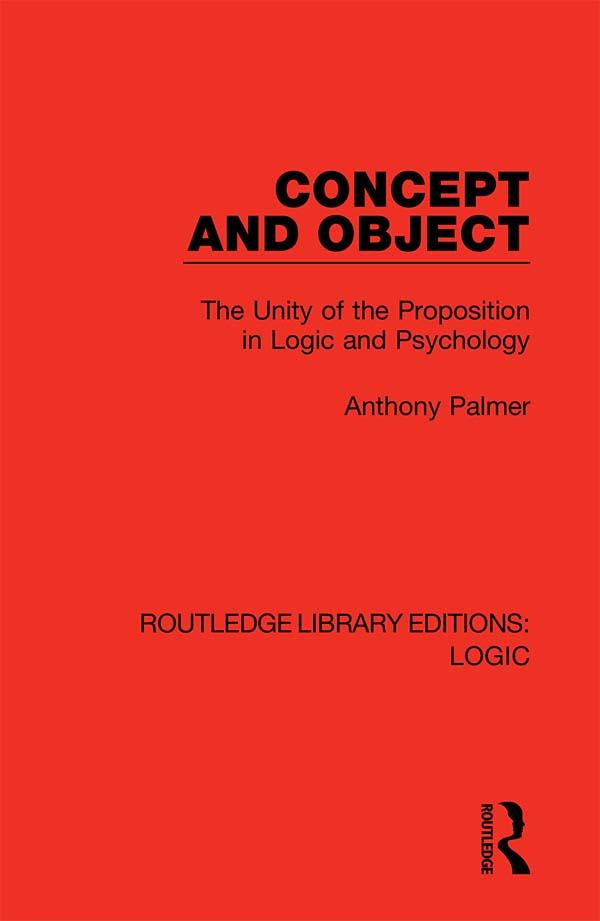
Originally published in 1988. This text gives a lucid account of the most distinctive and influential responses by twentieth century philosophers to the problem of the unity of the proposition. The problem first became central to twentieth-century philosophy as a result of the depsychoiogising of logic brought about by Bradley and Frege who, responding to the ’Psychologism’ of Mill and Hume, drew a sharp distinction between the province of psychology and the province of logic.
This author argues that while Russell, Ryle and Davidson, each in different ways, attempted a theoretical solution, Frege and Wittgenstein (both in the Tractatus and the Investigations) rightly maintained that no theoretical solution is possible. It is this which explains the importance Wittgenstein attached in his later work to the idea of agreement in judgments. The two final chapters illustrate the way in which a response to the problem affects the way in which we think about the nature of the mind. They contain a discussion of Strawson’s concept of a person and provide a striking critique of the philosophical claims made by devotees of artificial intelligence, in particular those made by Daniel Dennett.
Płać wygodnie kartą, Klarną, Apple Pay lub Google Pay. Nie jesteś zadowolony? Zawsze masz 14-dniową gwarancję zwrotu pieniędzy. Więcej przeczytasz w naszych warunkach. Masz pytania? Napisz do nas na hello@memmo.org.
Memmo ułatwia naukę – gdziekolwiek jesteś na świecie. U nas znajdziesz podręczniki i sprytne narzędzia do nauki w jednym miejscu: streszczenia, quizy, podcasty i fiszki. A do tego Ted, Twój kumpel do nauki, który odpowie na wszystko, co Cię nurtuje. Ponad 50 000 studentów już tu się uczy – stworzone, byś uczył się szybciej i mniej stresował.