
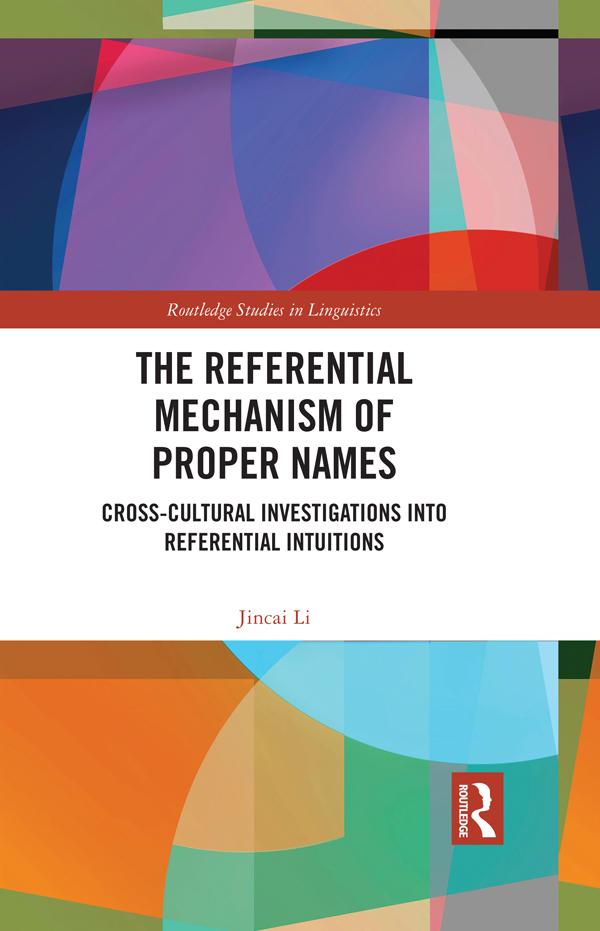
Each of us bears a unique name given to us at birth. When people use your name, they typically refer to you. But what is the linkage that ties a name to a person and hence allows it to refer?
Li’s book approaches this question of reference empirically through the medium of referential intuitions. Building on the literature on philosophical and linguistic intuitions, she proposes a linguistic-competence-based account of referential intuitions. Subsequently, using a series of novel experiments, she investigates the variation of referential intuitions across different cultures, as well as the developmental trajectory and the underlying causes of the observed cultural differences. What she finds is that the cultural patterns of referential intuitions are already in place around age seven, and the differences are largely attributable to the distinct perspective-taking strategies favoured by easterners and westerners, rather than the moral valence of actions involved in the experimental materials. These results are taken to better support referential pluralism (in particular, the ambiguous view) than referential monism.
By undertaking this fascinating research, Li’s book provides new insights into the cognitive mechanism underlying people’s referential usage of names. It will be valuable to students and scholars of linguistics, philosophy of language and experimental philosophy, and in particular, to those who research into semantic intuitions and theories of reference.
Płać wygodnie kartą, Klarną, Apple Pay lub Google Pay. Nie jesteś zadowolony? Zawsze masz 14-dniową gwarancję zwrotu pieniędzy. Więcej przeczytasz w naszych warunkach. Masz pytania? Napisz do nas na hello@memmo.org.
Memmo ułatwia naukę – gdziekolwiek jesteś na świecie. U nas znajdziesz podręczniki i sprytne narzędzia do nauki w jednym miejscu: streszczenia, quizy, podcasty i fiszki. A do tego Ted, Twój kumpel do nauki, który odpowie na wszystko, co Cię nurtuje. Ponad 50 000 studentów już tu się uczy – stworzone, byś uczył się szybciej i mniej stresował.