
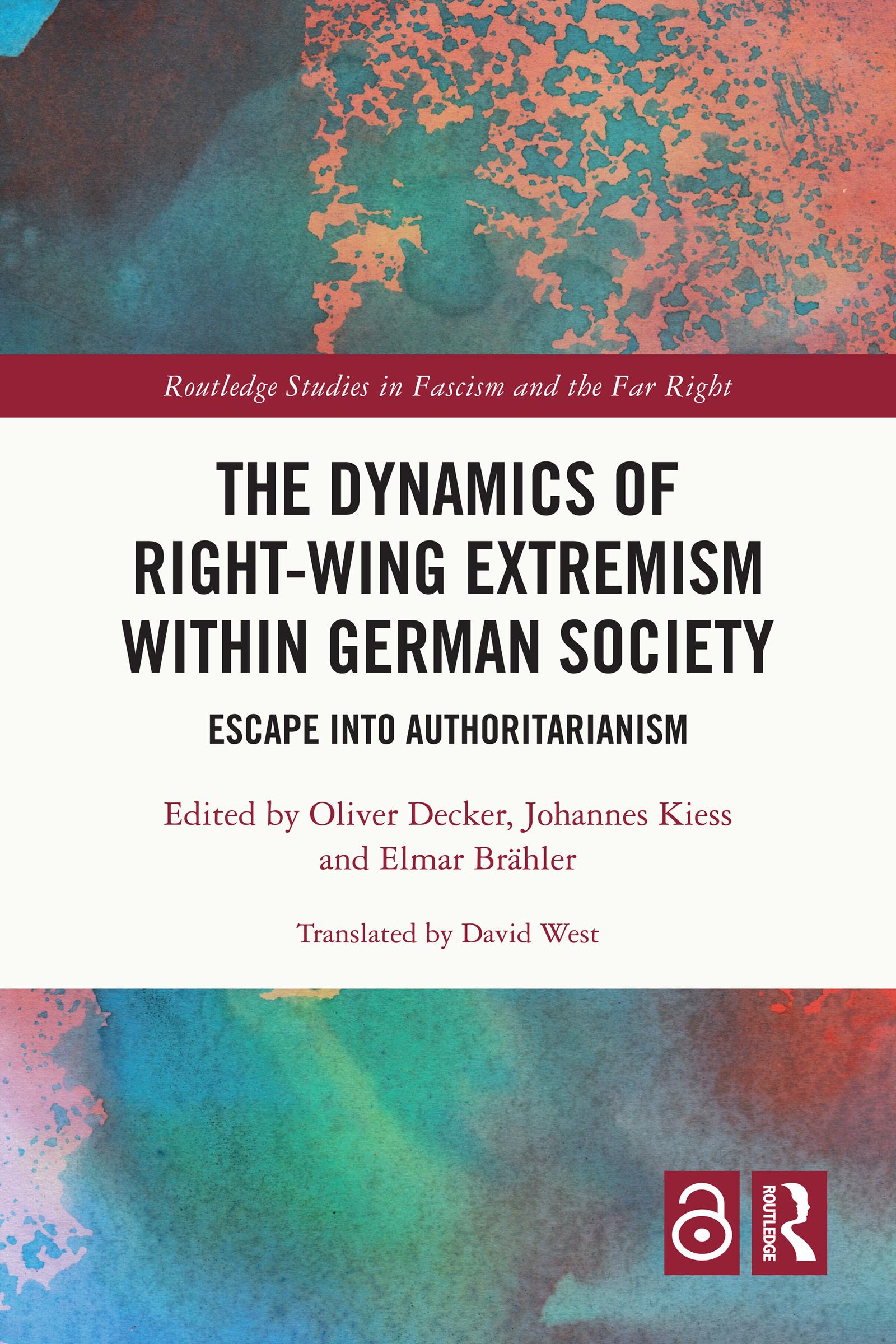
The Dynamics of Right-Wing Extremism within German Society explores the prevalence of right-wing extremist attitudes in Germany.
The book provides a thorough psychosocial and sociological theory of general authoritarian dynamics to explain broader societal attitudes, particularly focusing on right-wing extremism. It provides a uniquely long-term perspective on the different dimensions of right-wing extremism—the affinity for dictatorial forms of government, chauvinist attitudes, the trivialisation or justification of National Socialism, anti-Semitism, xenophobia, and social Darwinism. The first chapter delineates the theoretical framework of authoritarian dynamics, while subsequent chapters provide an in-depth analysis of empirical findings and distinguish authoritarian and democratic typologies. The authors focus on recognition of authoritarian statehood and anti-Semitism; the relationship between religion and right-wing extremism; and support for the radical-right populist party, Alternative für Deutschland (AfD). The innovative theoretical approach of this book scrutinizes the theory of authoritarianism in the contemporary world.
This book provides unique empirical data and will be of interest to scholars of German politics, anti-democratic attitudes and prejudices, sociology, political science, and social psychology.
The Open Access version of this book, available at www.taylorfrancis.com, has been made available under a Creative Commons Attribution-Non Commercial-No Derivatives 4.0 license.
Płać wygodnie kartą, Klarną, Apple Pay lub Google Pay. Nie jesteś zadowolony? Zawsze masz 14-dniową gwarancję zwrotu pieniędzy. Więcej przeczytasz w naszych warunkach. Masz pytania? Napisz do nas na hello@memmo.org.
Memmo ułatwia naukę – gdziekolwiek jesteś na świecie. U nas znajdziesz podręczniki i sprytne narzędzia do nauki w jednym miejscu: streszczenia, quizy, podcasty i fiszki. A do tego Ted, Twój kumpel do nauki, który odpowie na wszystko, co Cię nurtuje. Ponad 50 000 studentów już tu się uczy – stworzone, byś uczył się szybciej i mniej stresował.