
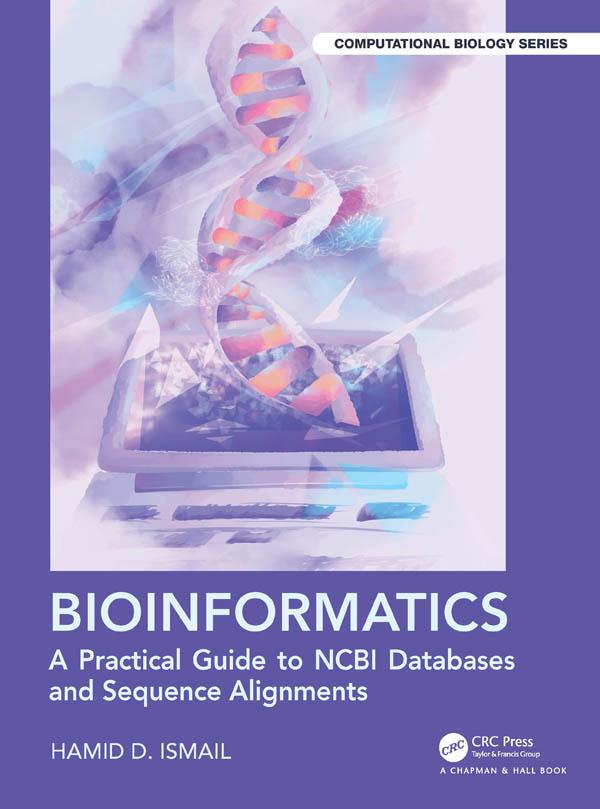
Bioinformatics: A Practical Guide to NCBI Databases and Sequence Alignments provides the basics of bioinformatics and in-depth coverage of NCBI databases, sequence alignment, and NCBI Sequence Local Alignment Search Tool (BLAST). As bioinformatics has become essential for life sciences, the book has been written specifically to address the need of a large audience including undergraduates, graduates, researchers, healthcare professionals, and bioinformatics professors who need to use the NCBI databases, retrieve data from them, and use BLAST to find evolutionarily related sequences, sequence annotation, construction of phylogenetic tree, and the conservative domain of a protein, to name just a few. Technical details of alignment algorithms are explained with a minimum use of mathematical formulas and with graphical illustrations.
Key Features
- Provides readers with the most-used bioinformatics knowledge of bioinformatics databases and alignments including both theory and application via illustrations and worked examples.
- Discusses the use of Windows Command Prompt, Linux shell, R, and Python for both Entrez databases and BLAST.
- The companion website (http://www.hamiddi.com/instructors/) contains tutorials, R and Python codes, instructor materials including slides, exercises, and problems for students.
This is the ideal textbook for bioinformatics courses taken by students of life sciences and for researchers wishing to develop their knowledge of bioinformatics to facilitate their own research.
Płać wygodnie kartą, Klarną, Apple Pay lub Google Pay. Nie jesteś zadowolony? Zawsze masz 14-dniową gwarancję zwrotu pieniędzy. Więcej przeczytasz w naszych warunkach. Masz pytania? Napisz do nas na hello@memmo.org.
Memmo ułatwia naukę – gdziekolwiek jesteś na świecie. U nas znajdziesz podręczniki i sprytne narzędzia do nauki w jednym miejscu: streszczenia, quizy, podcasty i fiszki. A do tego Ted, Twój kumpel do nauki, który odpowie na wszystko, co Cię nurtuje. Ponad 50 000 studentów już tu się uczy – stworzone, byś uczył się szybciej i mniej stresował.