
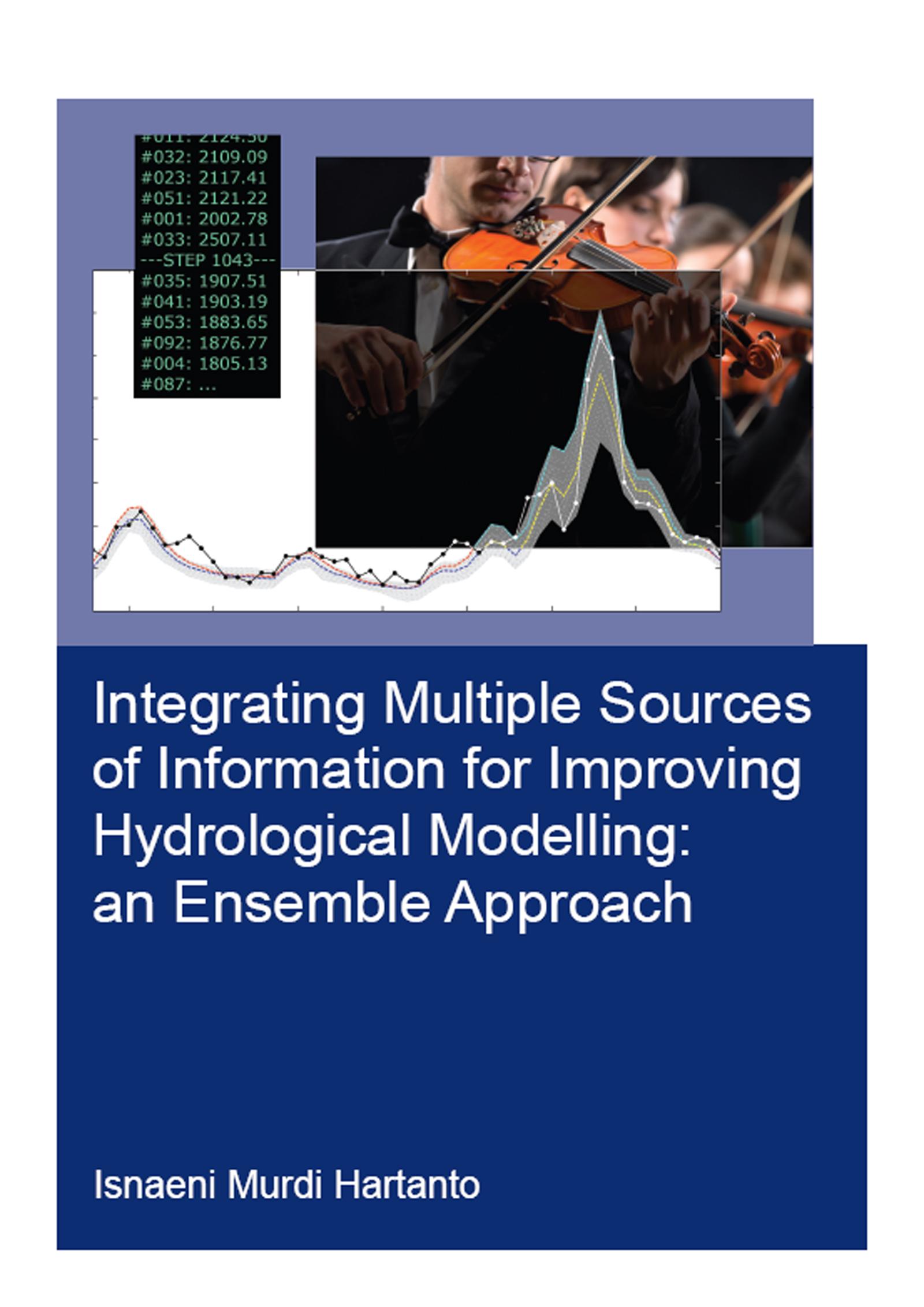
The availability of Earth observation and numerical weather prediction data for hydrological modelling and water management has increased significantly, creating a situation that today, for the same variable, estimates may be available from two or more sources of information. Yet, in hydrological modelling, usually, a particular set of catchment characteristics and input data is selected, possibly ignoring other relevant data sources. In this thesis, therefore, a framework is being proposed to enable effective use of multiple data sources in hydrological modelling.
In this framework, each available data source is used to derive catchment parameter values or input time series. Each unique combination of catchment and input data sources thus leads to a different hydrological simulation result: a new ensemble member. Together, the members form an ensemble of hydrological simulations. By following this approach, all available data sources are used effectively and their information is preserved. The framework also accommodates for applying multiple data-model integration methods, e.g. data assimilation. Each alternative integration method leads to yet another unique simulation result.
Case study results for a distributed hydrological model of Rijnland, the Netherlands, show that the framework can be applied effectively, improve discharge simulation, and partially account for parameter and data uncertainty.
Płać wygodnie kartą, Klarną, Apple Pay lub Google Pay. Nie jesteś zadowolony? Zawsze masz 14-dniową gwarancję zwrotu pieniędzy. Więcej przeczytasz w naszych warunkach. Masz pytania? Napisz do nas na hello@memmo.org.
Memmo ułatwia naukę – gdziekolwiek jesteś na świecie. U nas znajdziesz podręczniki i sprytne narzędzia do nauki w jednym miejscu: streszczenia, quizy, podcasty i fiszki. A do tego Ted, Twój kumpel do nauki, który odpowie na wszystko, co Cię nurtuje. Ponad 50 000 studentów już tu się uczy – stworzone, byś uczył się szybciej i mniej stresował.