
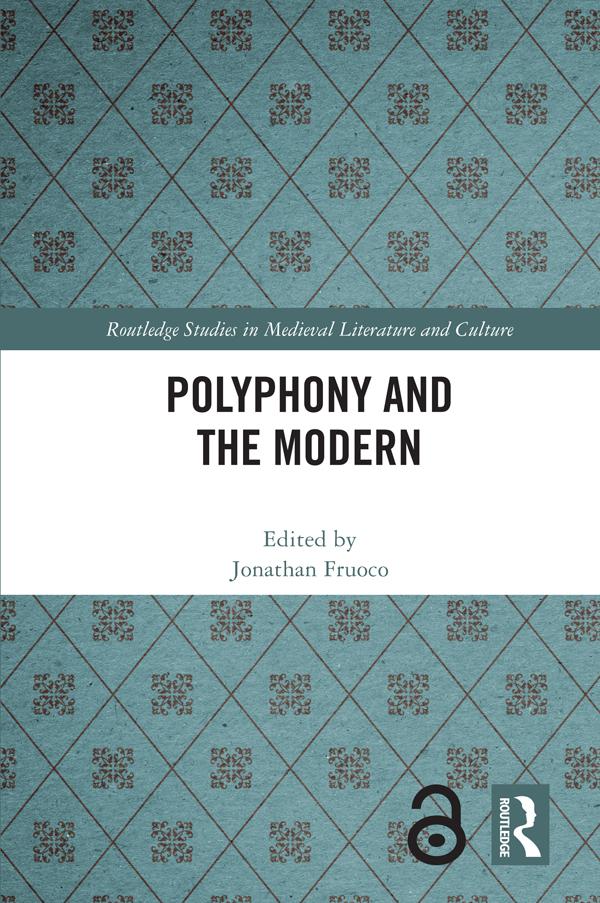
Polyphony and the Modern asks one fundamental question: what does it mean to be modern in one’s own time? To answer that question, this volume focuses on polyphony as an index of modernity.
In The Principle of Hope, Ernst Bloch showed that each moment in time is potentially fractured: people living in the same country can effectively live in different centuries – some making their alliances with the past and others betting on the future – but all of them, at least technically, enclosed in the temporal moment. But can a claim of modernity also mean something more ambitious? Can an artist, by accident or design, escape the limits of his or her own time, and somehow precociously embody the outlook of a subsequent age?
This book sees polyphony as a bridge providing a terminology and a stylistic practice by which the period barrier between Medieval and Early Modern can be breached.
Chapter 1 of this book is freely available as a downloadable Open Access PDF under a Creative Commons Attribution-Non Commercial-No Derivatives 4.0 license available at https://www.taylorfrancis.com/books/edit/10.4324/9781003129837
Płać wygodnie kartą, Klarną, Apple Pay lub Google Pay. Nie jesteś zadowolony? Zawsze masz 14-dniową gwarancję zwrotu pieniędzy. Więcej przeczytasz w naszych warunkach. Masz pytania? Napisz do nas na hello@memmo.org.
Memmo ułatwia naukę – gdziekolwiek jesteś na świecie. U nas znajdziesz podręczniki i sprytne narzędzia do nauki w jednym miejscu: streszczenia, quizy, podcasty i fiszki. A do tego Ted, Twój kumpel do nauki, który odpowie na wszystko, co Cię nurtuje. Ponad 50 000 studentów już tu się uczy – stworzone, byś uczył się szybciej i mniej stresował.