
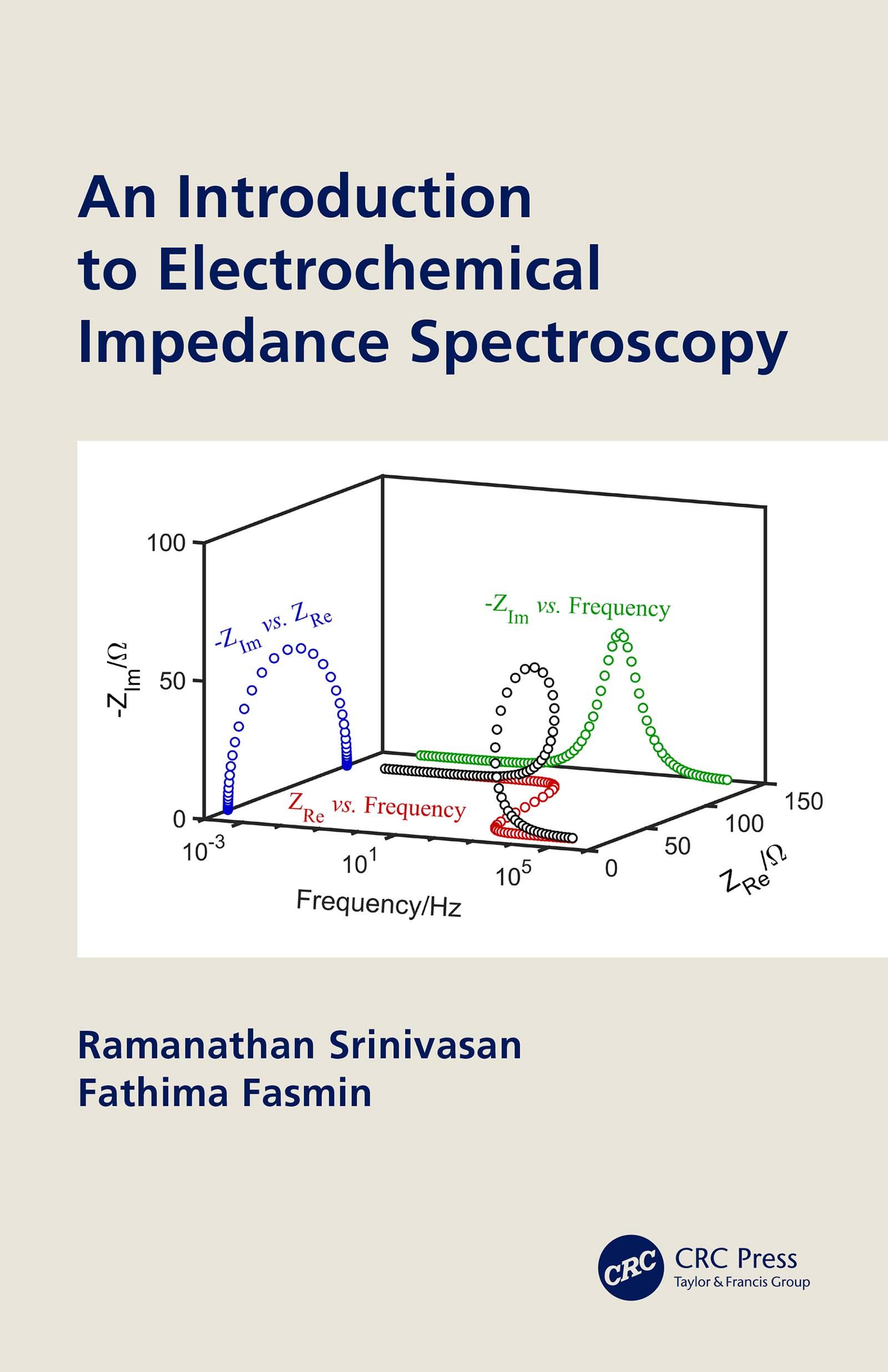
This book covers the fundamental aspects and the application of electrochemical impedance spectroscopy (EIS), with emphasis on a step-by-step procedure for mechanistic analysis of data. It enables the reader to learn the EIS technique, correctly acquire data from a system of interest, and effectively interpret the same. Detailed illustrations of how to validate the impedance spectra, use equivalent circuit analysis, and identify the reaction mechanism from the impedance spectra are given, supported by derivations and examples. MATLAB® programs for generating EIS data under various conditions are provided along with free online video lectures to enable easier learning.
Features:
- Covers experimental details and nuances, data validation method, and two types of analysis – using circuit analogy and mechanistic analysis
- Details observations such as inductive loops and negative resistances
- Includes a dedicated chapter on an emerging technique (Nonlinear EIS), including code in the supplementary material illustrating simulations
- Discusses diffusion, constant phase element, porous electrodes, and films
- Contains exercise problems, MATLAB codes, PPT slide, and illustrative examples
This book is aimed at senior undergraduates and advanced graduates in chemical engineering, analytical chemistry, electrochemistry, and spectroscopy.
Płać wygodnie kartą, Klarną, Apple Pay lub Google Pay. Nie jesteś zadowolony? Zawsze masz 14-dniową gwarancję zwrotu pieniędzy. Więcej przeczytasz w naszych warunkach. Masz pytania? Napisz do nas na hello@memmo.org.
Memmo ułatwia naukę – gdziekolwiek jesteś na świecie. U nas znajdziesz podręczniki i sprytne narzędzia do nauki w jednym miejscu: streszczenia, quizy, podcasty i fiszki. A do tego Ted, Twój kumpel do nauki, który odpowie na wszystko, co Cię nurtuje. Ponad 50 000 studentów już tu się uczy – stworzone, byś uczył się szybciej i mniej stresował.