
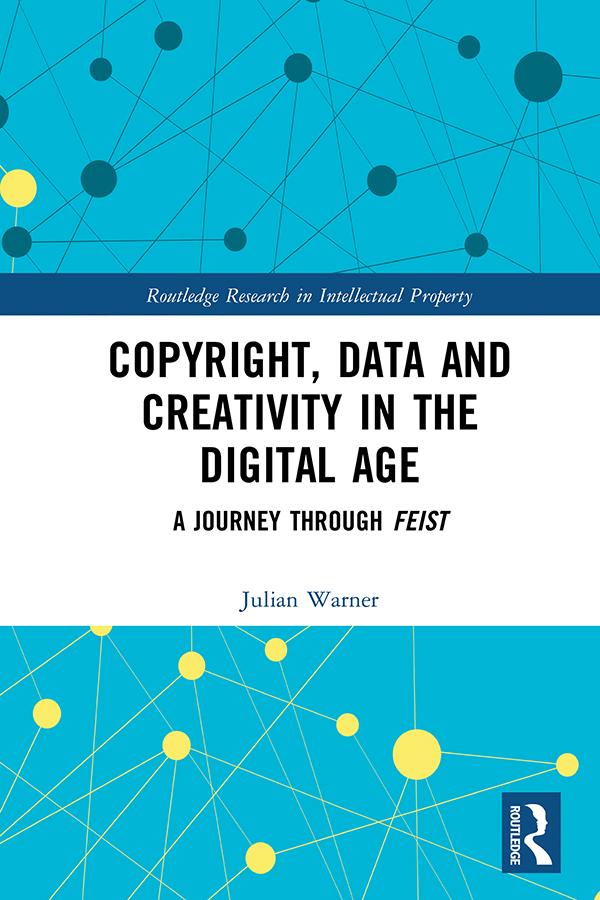
The Supreme Court of the United States in Feist v. Rural (1991) required that databases must have a minimal degree of creativity for copyright. The judgment was highly significant and the subsequent period is understood as the post-Feist era. It has been globally influential. However, the decision is extremely complex and remains unsatisfactorily interpreted. In particular, it has been impossible to illuminate the creativity requirement.
The book gives an account of the decision’s conceptual structure, focusing on its full delineation of the opposite to creativity. In a radical and unprecedented innovation, it is correlated with an automatic computational process. Creativity itself is understood as non-computational or directly human activity concerned with meaning. Determining the presence of creativity is reduced to a four-stage test. This work then has acute practical current relevance to property in data in the digital age; it will also be of theoretical interest to, and is aimed at, researchers in, practitioners, and students of intellectual property worldwide.
Płać wygodnie kartą, Klarną, Apple Pay lub Google Pay. Nie jesteś zadowolony? Zawsze masz 14-dniową gwarancję zwrotu pieniędzy. Więcej przeczytasz w naszych warunkach. Masz pytania? Napisz do nas na hello@memmo.org.
Memmo ułatwia naukę – gdziekolwiek jesteś na świecie. U nas znajdziesz podręczniki i sprytne narzędzia do nauki w jednym miejscu: streszczenia, quizy, podcasty i fiszki. A do tego Ted, Twój kumpel do nauki, który odpowie na wszystko, co Cię nurtuje. Ponad 50 000 studentów już tu się uczy – stworzone, byś uczył się szybciej i mniej stresował.