
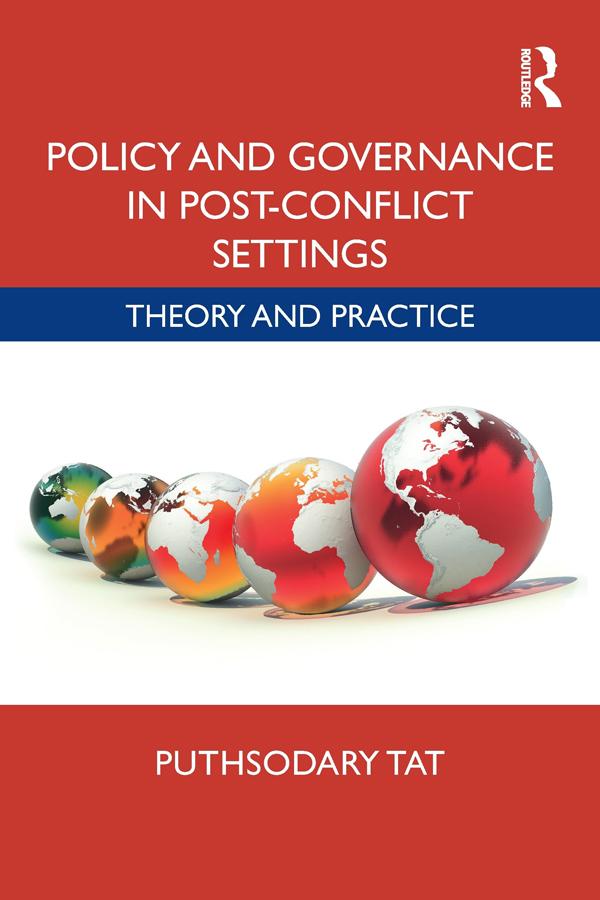
Post-conflict societies are commonly constructed as weak, fragile, and failed states. Economic recovery, risks of renewed violent conflict, natural resource degradation, and poverty alleviation become prioritized agendas of donor countries and international institutions. Billions of dollars on development policy and governance reform have been invested. However, misapplication, ineffectiveness, and foreign aid dependency have become a controversial debate on "whose policy, whose governance, and whose outcomes."
To understand the problems, the author employs a blend of social constructionism and discourse theory to establish a platform for understanding and discussing hegemonic aid conditionality on recipient governments. The theories also help analyze how the meanings of "post-conflict governance" are socially, economically, and politically constructed and used in state building, state apparatuses, institutional building, and policy-making process. He reveals that the philosophical and theoretical knowledge that underlies the interface between the mode of governance and policy design create the consensus of values, norms and indicators between experts, public servants, donors and communities in post-conflict settings. The author also shares illuminating case studies by way of his considerable wealth of experience leading reconstructive efforts in Afghanistan and Cambodia.
Płać wygodnie kartą, Klarną, Apple Pay lub Google Pay. Nie jesteś zadowolony? Zawsze masz 14-dniową gwarancję zwrotu pieniędzy. Więcej przeczytasz w naszych warunkach. Masz pytania? Napisz do nas na hello@memmo.org.
Memmo ułatwia naukę – gdziekolwiek jesteś na świecie. U nas znajdziesz podręczniki i sprytne narzędzia do nauki w jednym miejscu: streszczenia, quizy, podcasty i fiszki. A do tego Ted, Twój kumpel do nauki, który odpowie na wszystko, co Cię nurtuje. Ponad 50 000 studentów już tu się uczy – stworzone, byś uczył się szybciej i mniej stresował.