
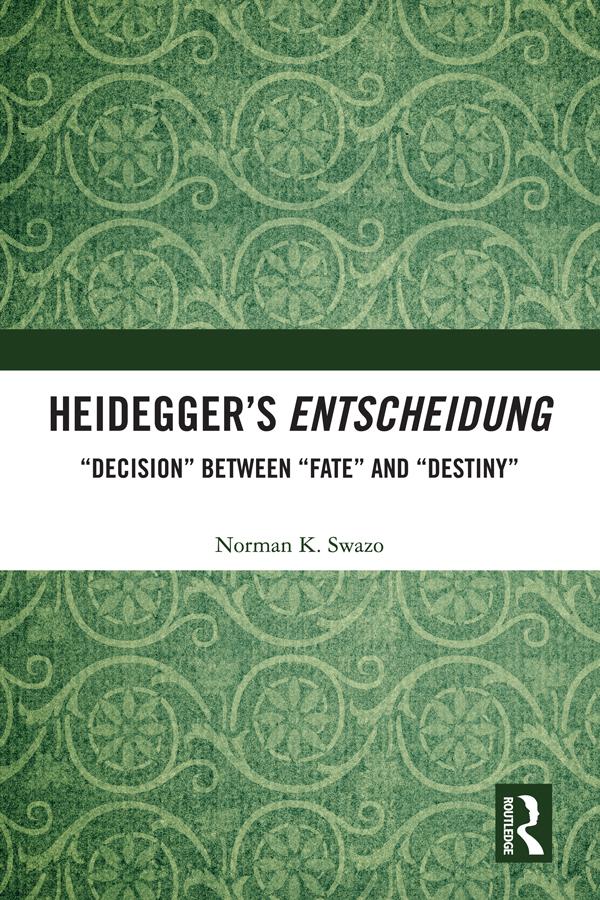
This book critically examines the debate on Martin Heidegger’s concept of Entscheidung ("decision") and his engagement and confrontation with Nazism in terms of his broader philosophical thought. It argues that one cannot explain Heidegger’s actions without accounting for his idea of "decision" and its connection to his understanding of individual "fate" and national (and European) "destiny." The book looks at the relation of biography to philosophy and the ethical and political implications of appropriating Heidegger’s thinking in these domains of inquiry. It highlights themes such as Heidegger’s differences with the neo-Kantians in Germany; Heidegger on Kant and practical reason; and his reading of Nietzsche and Hegel. It offers a philosophical assessment grounded in Heidegger’s own texts, with reference to historical and other philosophical commentaries on the rise of National Socialism in post-Weimar Germany and the philosophical issues associated with the interpretation of Nazi genocide and ideology.
An important intervention in Western philosophy, this book will be of great interest to scholars and researchers of political philosophy, continental philosophy, German philosophy, philosophy in general, and political studies.
Płać wygodnie kartą, Klarną, Apple Pay lub Google Pay. Nie jesteś zadowolony? Zawsze masz 14-dniową gwarancję zwrotu pieniędzy. Więcej przeczytasz w naszych warunkach. Masz pytania? Napisz do nas na hello@memmo.org.
Memmo ułatwia naukę – gdziekolwiek jesteś na świecie. U nas znajdziesz podręczniki i sprytne narzędzia do nauki w jednym miejscu: streszczenia, quizy, podcasty i fiszki. A do tego Ted, Twój kumpel do nauki, który odpowie na wszystko, co Cię nurtuje. Ponad 50 000 studentów już tu się uczy – stworzone, byś uczył się szybciej i mniej stresował.