
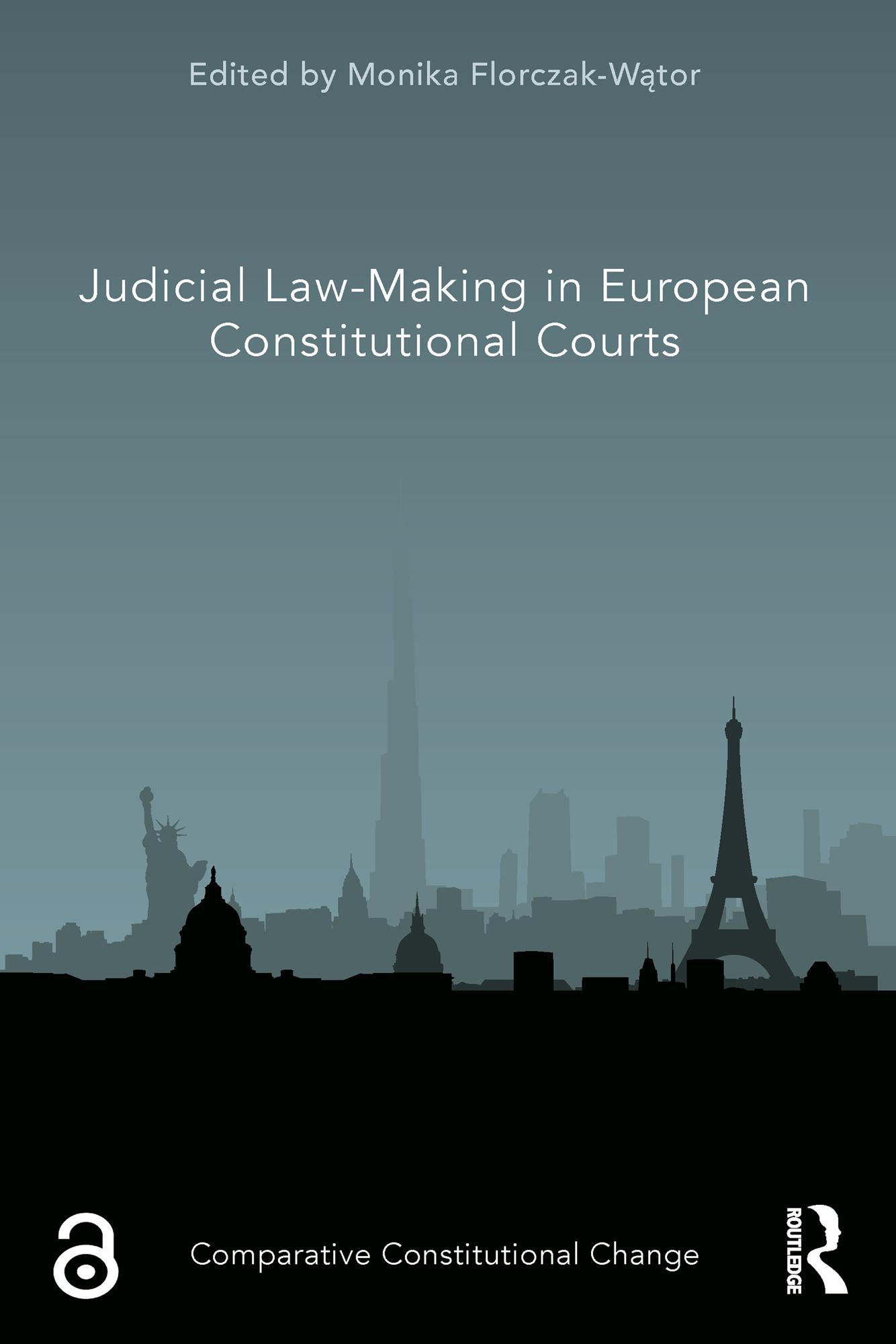
This book analyses the specificity of the law-making activity of European constitutional courts. The main hypothesis is that currently constitutional courts are positive legislators whose position in the system of State organs needs to be redefined.
The book covers the analysis of the law-making activity of four constitutional courts in Western countries: Germany, Italy, Spain, and France; and six constitutional courts in Central–East European countries: Poland, Hungary, the Czech Republic, Slovak Republic, Latvia, and Bulgaria; as well as two international courts: the European Court of Human Rights (ECtHR) and the Court of Justice of the European Union (CJEU). The work thus identifies the mutual interactions between national constitutional courts and international tribunals in terms of their law-making activity. The chosen countries include constitutional courts which have been recently captured by populist governments and subordinated to political powers. Therefore, one of the purposes of the book is to identify the change in the law-making activity of those courts and to compare it with the activity of constitutional courts from countries in which democracy is not viewed as being under threat. Written by national experts, each chapter addresses a series of set questions allowing accessible and meaningful comparison.
The book will be a valuable resource for students, academics, and policy-makers working in the areas of constitutional law and politics.
Płać wygodnie kartą, Klarną, Apple Pay lub Google Pay. Nie jesteś zadowolony? Zawsze masz 14-dniową gwarancję zwrotu pieniędzy. Więcej przeczytasz w naszych warunkach. Masz pytania? Napisz do nas na hello@memmo.org.
Memmo ułatwia naukę – gdziekolwiek jesteś na świecie. U nas znajdziesz podręczniki i sprytne narzędzia do nauki w jednym miejscu: streszczenia, quizy, podcasty i fiszki. A do tego Ted, Twój kumpel do nauki, który odpowie na wszystko, co Cię nurtuje. Ponad 50 000 studentów już tu się uczy – stworzone, byś uczył się szybciej i mniej stresował.