
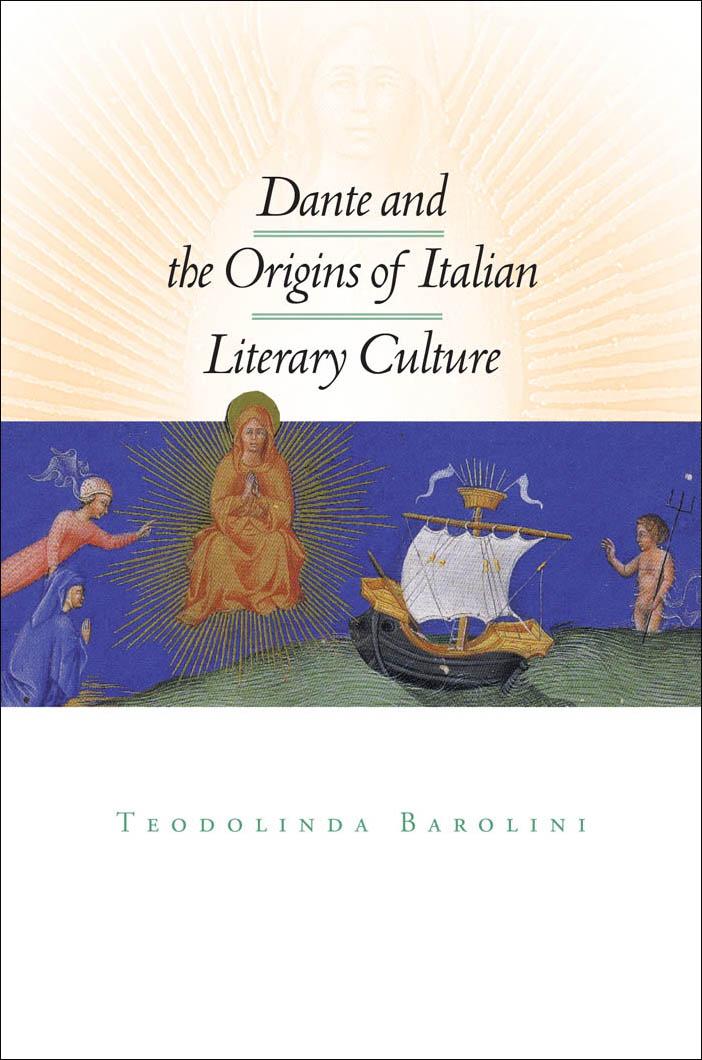
In this book, Teodolinda Barolini explores the sources of Italian literary culture in the figures of its lyric poets and its “three crowns”: Dante, Petrarch, and Boccaccio. Barolini views the origins of Italian literary culture through four prisms: the ideological/philosophical, the intertextual/multicultural, the structural/formal, and the social.
The essays in the first section treat the ideology of love and desire from the early lyric tradition to the Inferno and its antecedents in philosophy and theology. In the second, Barolini focuses on Dante as heir to both the Christian visionary and the classical pagan traditions (with emphasis on Vergil and Ovid). The essays in the third part analyze the narrative character of Dante’s Vita nuova, Petrarch’s lyric sequence, and Boccaccio’s Decameron. Barolini also looks at the cultural implications of the editorial history of Dante’s rime and at what sparso versus organico spells in the Italian imaginary. In the section on gender, she argues that the didactic texts intended for women’s use and instruction, as explored by Guittone, Dante, and Boccaccio—but not by Petrarch—were more progressive than the courtly style for which the Italian tradition is celebrated.
Moving from the lyric origins of the Divine Comedy in “Dante and the Lyric Past” to Petrarch’s regressive stance on gender in “Notes toward a Gendered History of Italian Literature”—and encompassing, among others, Giacomo da Lentini, Guido Cavalcanti, and Guittone d’Arezzo—these sixteen essays by one of our leading critics frame the literary culture of thirteenth-and fourteenth-century Italy in fresh, illuminating ways that will prove useful and instructive to students and scholars alike.
Płać wygodnie kartą, Klarną, Apple Pay lub Google Pay. Nie jesteś zadowolony? Zawsze masz 14-dniową gwarancję zwrotu pieniędzy. Więcej przeczytasz w naszych warunkach. Masz pytania? Napisz do nas na hello@memmo.org.
Memmo ułatwia naukę – gdziekolwiek jesteś na świecie. U nas znajdziesz podręczniki i sprytne narzędzia do nauki w jednym miejscu: streszczenia, quizy, podcasty i fiszki. A do tego Ted, Twój kumpel do nauki, który odpowie na wszystko, co Cię nurtuje. Ponad 50 000 studentów już tu się uczy – stworzone, byś uczył się szybciej i mniej stresował.