
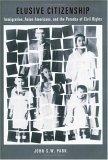
Since the late nineteenth century, federal and state rules governing immigration and naturalization have placed persons of Asian ancestry outside the boundaries of formal membership. A review of leading cases in American constitutional law regarding Asians would suggest that initially, Asian immigrants tended to evade exclusionary laws through deliberate misrepresentations of their identities or through extralegal means. Eventually, many of these immigrants and their descendants came to accept prevailing legal norms governing their citizenship in the United States. In many cases, this involved embracing notions of white supremacy.
John S. W. Park argues that American rules governing citizenship and belonging remain fundamentally unjust, even though they suggest the triumph of a "civil rights" vision, where all citizens share the same basic rights. By continuing to privilege members over non-members in ways that are politically popular, these rules mask injustices that violate principles of fairness. Importantly, Elusive Citizenship also suggests that politically and socially, full membership in American society remains closely linked with participation in exclusionary practices that isolate racial minorities in America.
Płać wygodnie kartą, Klarną, Apple Pay lub Google Pay. Nie jesteś zadowolony? Zawsze masz 14-dniową gwarancję zwrotu pieniędzy. Więcej przeczytasz w naszych warunkach. Masz pytania? Napisz do nas na hello@memmo.org.
Memmo ułatwia naukę – gdziekolwiek jesteś na świecie. U nas znajdziesz podręczniki i sprytne narzędzia do nauki w jednym miejscu: streszczenia, quizy, podcasty i fiszki. A do tego Ted, Twój kumpel do nauki, który odpowie na wszystko, co Cię nurtuje. Ponad 50 000 studentów już tu się uczy – stworzone, byś uczył się szybciej i mniej stresował.