
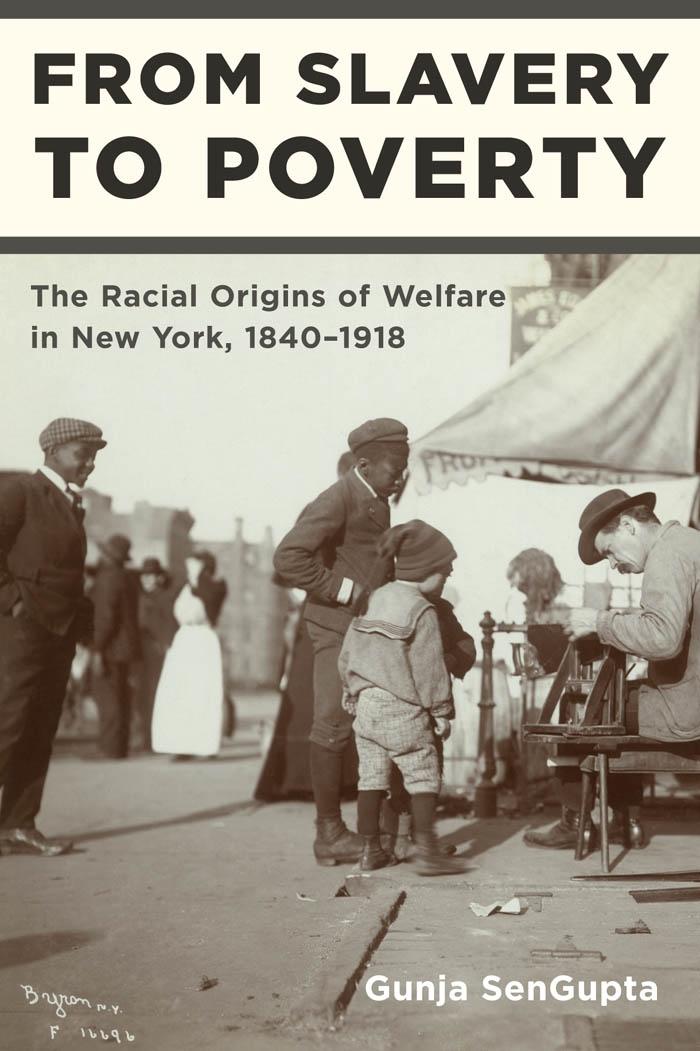
The racially charged stereotype of "welfare queen"—an allegedly promiscuous waster who uses her children as meal tickets funded by tax-payers—is a familiar icon in modern America, but as Gunja SenGupta reveals in From Slavery to Poverty, her historical roots run deep. For, SenGupta argues, the language and institutions of poor relief and reform have historically served as forums for inventing and negotiating identity.
Mining a broad array of sources on nineteenth-century New York City’s interlocking network of private benevolence and municipal relief, SenGupta shows that these institutions promoted a racialized definition of poverty and citizenship. But they also offered a framework within which working poor New Yorkers—recently freed slaves and disfranchised free blacks, Afro-Caribbean sojourners and Irish immigrants, sex workers and unemployed laborers, and mothers and children—could challenge stereotypes and offer alternative visions of community. Thus, SenGupta argues, long before the advent of the twentieth-century welfare state, the discourse of welfare in its nineteenth-century incarnation created a space to talk about community, race, and nation; about what it meant to be “American,” who belonged, and who did not. Her work provides historical context for understanding why today the notion of "welfare"—with all its derogatory “un-American” connotations—is associated not with middle-class entitlements like Social Security and Medicare, but rather with programs targeted at the poor, which are wrongly assumed to benefit primarily urban African Americans.
Płać wygodnie kartą, Klarną, Apple Pay lub Google Pay. Nie jesteś zadowolony? Zawsze masz 14-dniową gwarancję zwrotu pieniędzy. Więcej przeczytasz w naszych warunkach. Masz pytania? Napisz do nas na hello@memmo.org.
Memmo ułatwia naukę – gdziekolwiek jesteś na świecie. U nas znajdziesz podręczniki i sprytne narzędzia do nauki w jednym miejscu: streszczenia, quizy, podcasty i fiszki. A do tego Ted, Twój kumpel do nauki, który odpowie na wszystko, co Cię nurtuje. Ponad 50 000 studentów już tu się uczy – stworzone, byś uczył się szybciej i mniej stresował.