
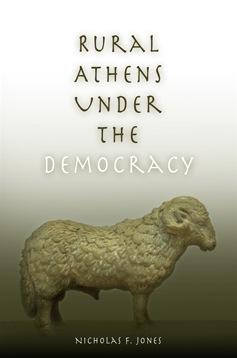
Much of the evidence—literary, historical, documentary, and pictorial—from ancient Athens is urban in authorship, subject matter, and intended audience. The result has been the assertion of an undifferentiated monolithic "Athenian" citizen regime as often as not identifiably urban in its lifestyle, preoccupations, and attitude. In Rural Athens Under the Democracy, however, Nicholas F. Jones undertakes the first comprehensive attempt to reconstruct on its own terms the world of rural Attica outside the walls during the "classical" fifth and fourth centuries B.C. What he finds is a distinctly nonurban (and nonurbane) order dominated by a traditional, predominantly agrarian society and culture.
Jones relies heavily upon the relatively neglected epigraphic record from the rural countryside and villages, as well as posing new questions of the well-known urban writings of Athenian historians, essayists, and philosophers and occasionally following the lead of Hesiod's agrarian poem Works and Days. From these sources he gleans new findings regarding settlement patterns, argues for a heretofore unrecognized system of personal patronage, explores relations between villages and the town of Athens, reconstructs the "Agrarian" Dionysia in several of its more important dimensions, and contrasts the realities of rural Attic culture with their various representations in contemporary literary and philosophical writings by Aristophanes, Xenophon, Plato, and others.
Building on Jones's previous publications on the ancient Greek city-state, Rural Athens Under the Democracy presents the first holistic examination of classical extramural Attica. He challenges the received view that ancient Athens in its heyday was marked by a uniform cultural, ideological, and conspicuously citified order and, in place of the perception of things rural as mere deficits in urbanity, proposes that we look at Attica outside the walls in its own right and in positive terms.
Płać wygodnie kartą, Klarną, Apple Pay lub Google Pay. Nie jesteś zadowolony? Zawsze masz 14-dniową gwarancję zwrotu pieniędzy. Więcej przeczytasz w naszych warunkach. Masz pytania? Napisz do nas na hello@memmo.org.
Memmo ułatwia naukę – gdziekolwiek jesteś na świecie. U nas znajdziesz podręczniki i sprytne narzędzia do nauki w jednym miejscu: streszczenia, quizy, podcasty i fiszki. A do tego Ted, Twój kumpel do nauki, który odpowie na wszystko, co Cię nurtuje. Ponad 50 000 studentów już tu się uczy – stworzone, byś uczył się szybciej i mniej stresował.