
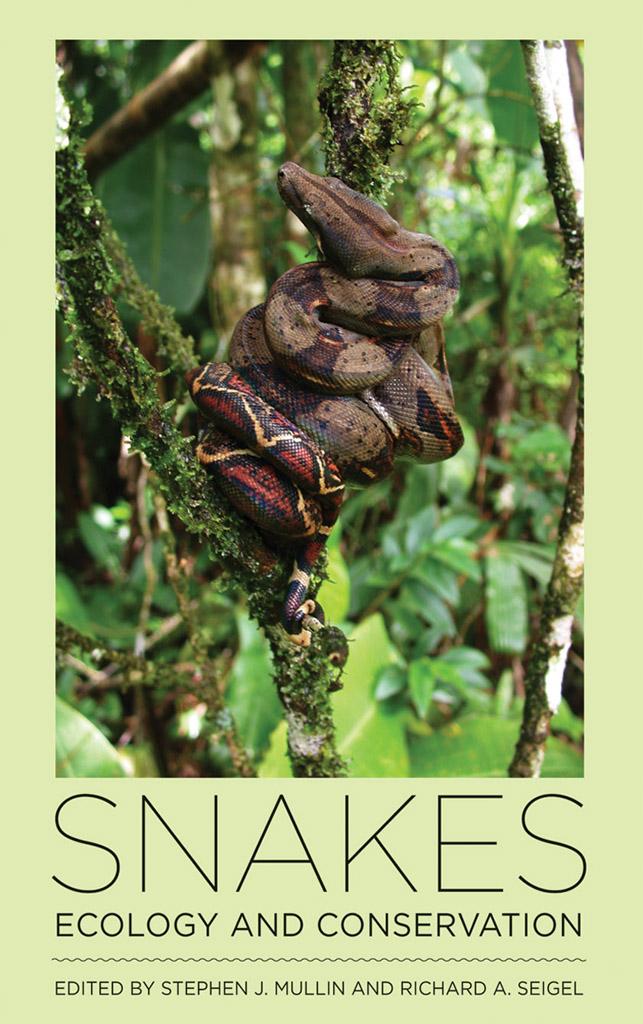
Destruction of habitat due to urban sprawl, pollution, and deforestation has caused population declines or even extinction of many of the world's approximately 2,600 snake species. Furthermore, misconceptions about snakes have made them among the most persecuted of all animals, despite the fact that less than a quarter of all species are venomous and most species are beneficial because they control rodent pests. It has become increasingly urgent, therefore, to develop viable conservation strategies for snakes and to investigate their importance as monitors of ecosystem health and indicators of habitat sustainability.
In the first book on snakes written with a focus on conservation, editors Stephen J. Mullin and Richard A. Seigel bring together leading herpetologists to review and synthesize the ecology, conservation, and management of snakes worldwide. These experts report on advances in current research and summarize the primary literature, presenting the most important concepts and techniques in snake ecology and conservation. The common thread of conservation unites the twelve chapters, each of which addresses a major subdiscipline within snake ecology. Applied topics such as methods and modeling and strategies such as captive rearing and translocation are also covered. Each chapter provides an essential framework and indicates specific directions for future research, making this a critical reference for anyone interested in vertebrate conservation generally or for anyone implementing conservation and management policies concerning snake populations.
Contributors: Omar Attum, Indiana University Southeast; Steven J. Beaupre, University of Arkansas; Xavier Bonnet, Centre National de la Recherche Scientifique; Frank T. Burbrink, College of Staten Island-The City University of New York; Gordon M. Burghardt, University of Tennessee; Todd A. Castoe, University of Colorado; David Chiszar, University of Colorado; Michael E. Dorcas, Davidson College; Lara E. Douglas, University of Arkansas; Christopher L. Jenkins, Project Orianne, Ltd.; Glenn Johnson, State University of New York at Potsdam; Michael Hutchins, The Wildlife Society; Richard B. King, Northern Illinois University; Bruce A. Kingsbury, Indiana University-Purdue University Fort Wayne; Thomas Madsen, University of Wollongong; Stephen J. Mullin, Eastern Illinois University; James B. Murphy, National Zoological Park; Charles R. Peterson, Idaho State University; Kent A. Prior, Parks Canada; Richard A. Seigel, Towson University; Richard Shine, University of Sydney; Kevin T. Shoemaker, College of Environmental Science and Forestry, State University of New York; Patrick J. Weatherhead, University of Illinois; John D. Willson, University of Georgia
Płać wygodnie kartą, Klarną, Apple Pay lub Google Pay. Nie jesteś zadowolony? Zawsze masz 14-dniową gwarancję zwrotu pieniędzy. Więcej przeczytasz w naszych warunkach. Masz pytania? Napisz do nas na hello@memmo.org.
Memmo ułatwia naukę – gdziekolwiek jesteś na świecie. U nas znajdziesz podręczniki i sprytne narzędzia do nauki w jednym miejscu: streszczenia, quizy, podcasty i fiszki. A do tego Ted, Twój kumpel do nauki, który odpowie na wszystko, co Cię nurtuje. Ponad 50 000 studentów już tu się uczy – stworzone, byś uczył się szybciej i mniej stresował.