
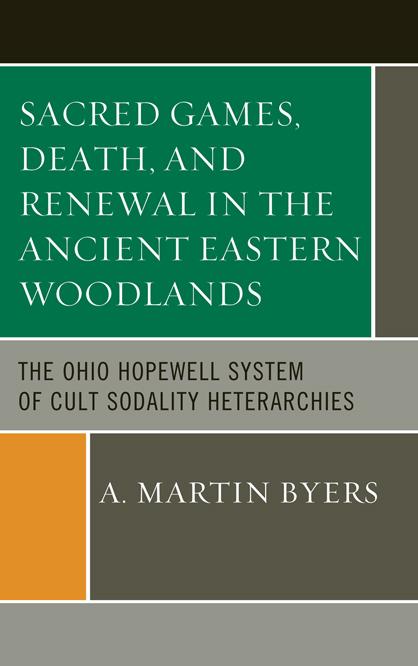
The book presents an account of the Ohio Middle Woodland period embankment earthworks, ca 100 B.C. to A.D. 400, that is radically different from the prevailing theory. Byers critically addresses all the arguments and characterizations that make up the current treatment of the embankment earthworks and then presents an alternative interpretation.
This unconventional view hinges on two basic social characterizations: the complementary heterarchical community model and the cult sodality heterarchy model. Byers posits that these two models interact to characterize the Ohio Middle Woodland period settlement pattern; the community was constituted by autonomous social formations: clans based on kinship and sodalities based on companionship. The individual communities of the region each have their clan components dispersed within a fairly well-defined zone while the sodality components of the same set of region-wide communities ally with each other and build and operate the embankment earthworks. This dichotomy is possible only because the clans and sodalities respect each other as relatively autonomous; the affairs of the clans, focusing on domestic and family matters, remain outside the concerns of the sodalities and the affairs of the sodalities, focusing on world renewal and sacred games, remain outside the concerns of the clans. Therefore, two models are required to understand the embankment earthworks and no individual earthwork can be identified with any particular community.
This radical interpretation grounded in empirical archaeological data, as well as the in-depth overview of the current theory of the Ohio Middle Woodland period, make this book a critically important addition to the perspective of scholars of North American archaeology and scholars grappling with prehistoric social systems.
This unconventional view hinges on two basic social characterizations: the complementary heterarchical community model and the cult sodality heterarchy model. Byers posits that these two models interact to characterize the Ohio Middle Woodland period settlement pattern; the community was constituted by autonomous social formations: clans based on kinship and sodalities based on companionship. The individual communities of the region each have their clan components dispersed within a fairly well-defined zone while the sodality components of the same set of region-wide communities ally with each other and build and operate the embankment earthworks. This dichotomy is possible only because the clans and sodalities respect each other as relatively autonomous; the affairs of the clans, focusing on domestic and family matters, remain outside the concerns of the sodalities and the affairs of the sodalities, focusing on world renewal and sacred games, remain outside the concerns of the clans. Therefore, two models are required to understand the embankment earthworks and no individual earthwork can be identified with any particular community.
This radical interpretation grounded in empirical archaeological data, as well as the in-depth overview of the current theory of the Ohio Middle Woodland period, make this book a critically important addition to the perspective of scholars of North American archaeology and scholars grappling with prehistoric social systems.
Strony: 558
Kategoria: Arkeologi & Antikvetenskap
e-ISBN: 9780759120341
Waga przesyłki: 1.2 kg
Wysyłka w ciągu: 1-2 dni
Płać wygodnie kartą, Klarną, Apple Pay lub Google Pay. Nie jesteś zadowolony? Zawsze masz 14-dniową gwarancję zwrotu pieniędzy. Więcej przeczytasz w naszych warunkach. Masz pytania? Napisz do nas na hello@memmo.org.
Memmo ułatwia naukę – gdziekolwiek jesteś na świecie. U nas znajdziesz podręczniki i sprytne narzędzia do nauki w jednym miejscu: streszczenia, quizy, podcasty i fiszki. A do tego Ted, Twój kumpel do nauki, który odpowie na wszystko, co Cię nurtuje. Ponad 50 000 studentów już tu się uczy – stworzone, byś uczył się szybciej i mniej stresował.