
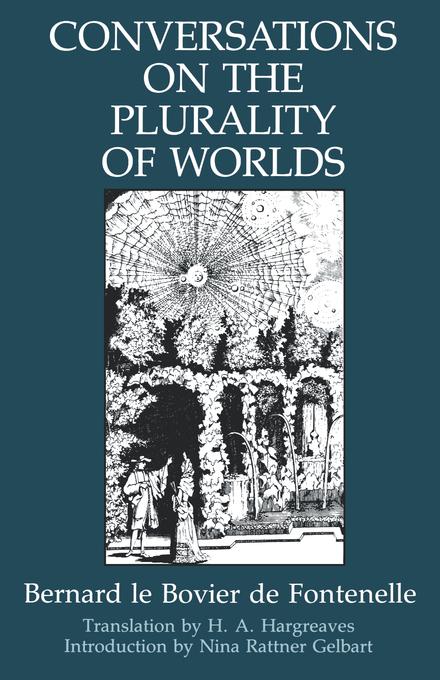
Surveying the night sky, a charming philosopher and his hostess, the Marquise, are considering thep ossibility of travelers from the moon. "What if they were skillful enough to navigate on the outer surface of our air, and from there, through their curiosity to see us, they angled for us like fish? Would that please you?" asks the philosopher. "Why not?" the Marquise replies. "As for me, I'd put myself into their nets of my own volition just to have the pleasure of seeing those who caught me."
In this imaginary conversation of three hundred years ago, readers can share the excitement of a new, extremely daring view of the uinverse. Conversations on the Plurality of Worlds (Entretiens sur la pluralité des mondes), first published in 1686, is one of the best loved classics of the early French enlightenment. Through a series of informal dialogues that take place on successive evenings in the marquise's moonlit gardens, Fontenelle describes the new cosmology of the Copernican world view with matchles clarity, imagination, and wit. Moreover, he boldly makes his interlocutor a woman, inviting female participation in the almost exclusively male province of scientific discourse.
The popular Fontenelle lived through an entire century, from 1657 to 1757, and wrote prolifically. H. A. Hargreaves's fresh, appealing translation brings the author's masterpiece to new generations of readers, while the introduction by Nina Rattner Gelbart clearly demonstrates the importance of the Conversations for the history of science, of women, of literature, and of French civilization, and for the popularization of culture.
In this imaginary conversation of three hundred years ago, readers can share the excitement of a new, extremely daring view of the uinverse. Conversations on the Plurality of Worlds (Entretiens sur la pluralité des mondes), first published in 1686, is one of the best loved classics of the early French enlightenment. Through a series of informal dialogues that take place on successive evenings in the marquise's moonlit gardens, Fontenelle describes the new cosmology of the Copernican world view with matchles clarity, imagination, and wit. Moreover, he boldly makes his interlocutor a woman, inviting female participation in the almost exclusively male province of scientific discourse.
The popular Fontenelle lived through an entire century, from 1657 to 1757, and wrote prolifically. H. A. Hargreaves's fresh, appealing translation brings the author's masterpiece to new generations of readers, while the introduction by Nina Rattner Gelbart clearly demonstrates the importance of the Conversations for the history of science, of women, of literature, and of French civilization, and for the popularization of culture.
Płać wygodnie kartą, Klarną, Apple Pay lub Google Pay. Nie jesteś zadowolony? Zawsze masz 14-dniową gwarancję zwrotu pieniędzy. Więcej przeczytasz w naszych warunkach. Masz pytania? Napisz do nas na hello@memmo.org.
Memmo ułatwia naukę – gdziekolwiek jesteś na świecie. U nas znajdziesz podręczniki i sprytne narzędzia do nauki w jednym miejscu: streszczenia, quizy, podcasty i fiszki. A do tego Ted, Twój kumpel do nauki, który odpowie na wszystko, co Cię nurtuje. Ponad 50 000 studentów już tu się uczy – stworzone, byś uczył się szybciej i mniej stresował.
Może Ci się spodobać
Kup książkę0