
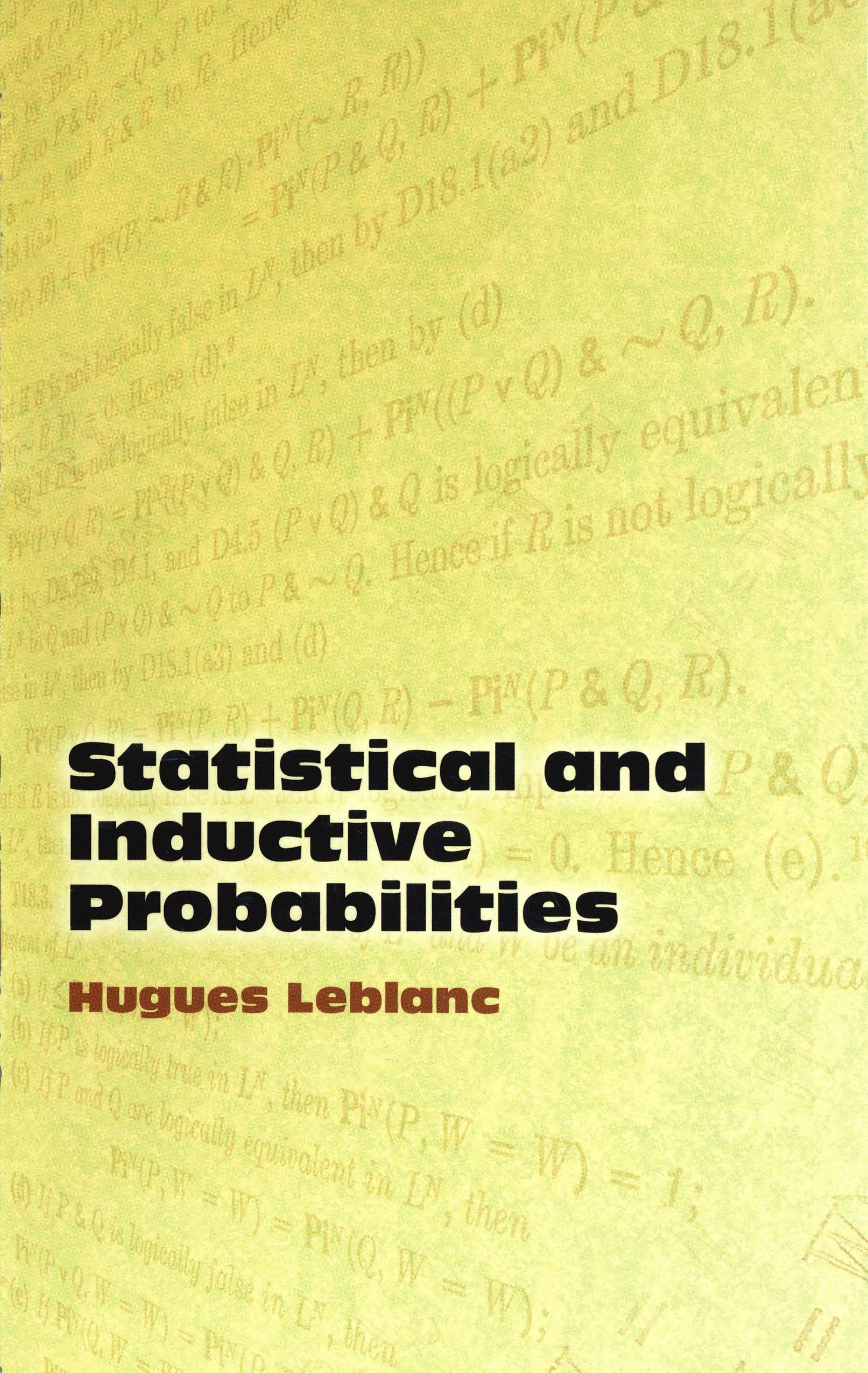
Among probability theorists, a bitter controversy has raged for decades between the adherents of John Maynard Keynes' A Treatise on Probability (1921) and those of Richard von Mises' "Grundlagen der Wahrscheinlichkeitsrechnung" (1919). Keynes declared that probabilities measure the extent to which a so-called evidence proposition supports another sentence. Von Mises insisted that they measure the relative frequency with which the members of a so-called reference set belong to another set. Statistical and Inductive Probabilities offers an evenhanded treatment of this issue, asserting that both statistical and inductive probabilities may be treated as sentence-theoretic measurements, and that the latter qualify as estimates of the former.
Beginning with a survey of the essentials of sentence theory and of set theory, author Hugues Leblanc examines statistical probabilities (which are allotted to sets by von Mises' followers), showing that statistical probabilities may be passed on to sentences, and thereby qualify as truth-values. Leblanc concludes with an exploration of inductive probabilities (which Keynes' followers allot to sentences), demonstrating their reinterpretation as estimates of truth-values.
Each chapter is preceded by a summary of its contents. Illustrations accompany most definitions and theorems, and footnotes elucidate technicalities and bibliographical references.
Beginning with a survey of the essentials of sentence theory and of set theory, author Hugues Leblanc examines statistical probabilities (which are allotted to sets by von Mises' followers), showing that statistical probabilities may be passed on to sentences, and thereby qualify as truth-values. Leblanc concludes with an exploration of inductive probabilities (which Keynes' followers allot to sentences), demonstrating their reinterpretation as estimates of truth-values.
Each chapter is preceded by a summary of its contents. Illustrations accompany most definitions and theorems, and footnotes elucidate technicalities and bibliographical references.
Płać wygodnie kartą, Klarną, Apple Pay lub Google Pay. Nie jesteś zadowolony? Zawsze masz 14-dniową gwarancję zwrotu pieniędzy. Więcej przeczytasz w naszych warunkach. Masz pytania? Napisz do nas na hello@memmo.org.
Memmo ułatwia naukę – gdziekolwiek jesteś na świecie. U nas znajdziesz podręczniki i sprytne narzędzia do nauki w jednym miejscu: streszczenia, quizy, podcasty i fiszki. A do tego Ted, Twój kumpel do nauki, który odpowie na wszystko, co Cię nurtuje. Ponad 50 000 studentów już tu się uczy – stworzone, byś uczył się szybciej i mniej stresował.
Może Ci się spodobać
Kup książkę0