
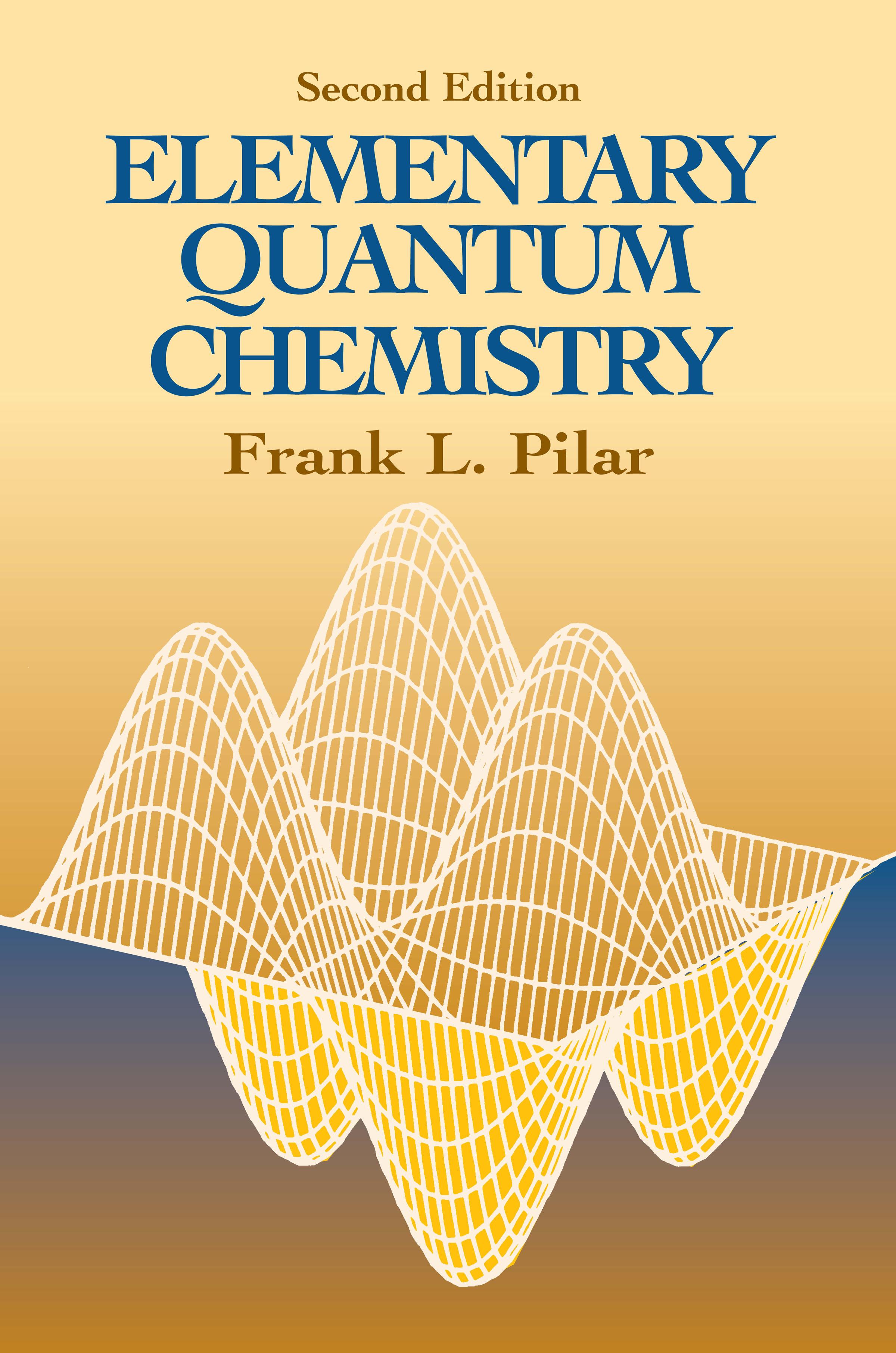
As the author notes in the Preface to this valuable text, experimental chemists have moved past studying the average behavior of atoms or molecules "to probe the step-by-step behavior of individual atoms and molecules as they collide, form 'transition states,' and ultimately form products." In such experiments, quantum mechanical computations do two useful tasks: They fill in the observational gaps and help to interpret what has been observed.
This introductory course — developed by the former chairman of the chemistry department at the University of New Hampshire — covers, among other topics, the origins of the quantum theory, the Schrödinger wave equation, the quantum mechanics of simple systems, the rigid rotator, the hydrogen atom, electron spin and many-electron systems, the quantum states of atoms, the Hartree-Fock self-consistent field method, the electronic structure of molecules, and semi-empirical molecular orbital methods. One of the great values of the course is its calculations and diagrams, which were created specifically for this text and which students will be able to replicate on their home computers.
The text will be most useful for advanced undergraduate or beginning graduate students who have had calculus and at least a year of undergraduate physics. A knowledge of differential equations, linear algebra, and atomic physics is helpful but not essential. Seven appendices give a concise exposition of mathematical and physical material that may not be part of the students' background.
This introductory course — developed by the former chairman of the chemistry department at the University of New Hampshire — covers, among other topics, the origins of the quantum theory, the Schrödinger wave equation, the quantum mechanics of simple systems, the rigid rotator, the hydrogen atom, electron spin and many-electron systems, the quantum states of atoms, the Hartree-Fock self-consistent field method, the electronic structure of molecules, and semi-empirical molecular orbital methods. One of the great values of the course is its calculations and diagrams, which were created specifically for this text and which students will be able to replicate on their home computers.
The text will be most useful for advanced undergraduate or beginning graduate students who have had calculus and at least a year of undergraduate physics. A knowledge of differential equations, linear algebra, and atomic physics is helpful but not essential. Seven appendices give a concise exposition of mathematical and physical material that may not be part of the students' background.
Płać wygodnie kartą, Klarną, Apple Pay lub Google Pay. Nie jesteś zadowolony? Zawsze masz 14-dniową gwarancję zwrotu pieniędzy. Więcej przeczytasz w naszych warunkach. Masz pytania? Napisz do nas na hello@memmo.org.
Memmo ułatwia naukę – gdziekolwiek jesteś na świecie. U nas znajdziesz podręczniki i sprytne narzędzia do nauki w jednym miejscu: streszczenia, quizy, podcasty i fiszki. A do tego Ted, Twój kumpel do nauki, który odpowie na wszystko, co Cię nurtuje. Ponad 50 000 studentów już tu się uczy – stworzone, byś uczył się szybciej i mniej stresował.
Może Ci się spodobać
Kup książkę0