
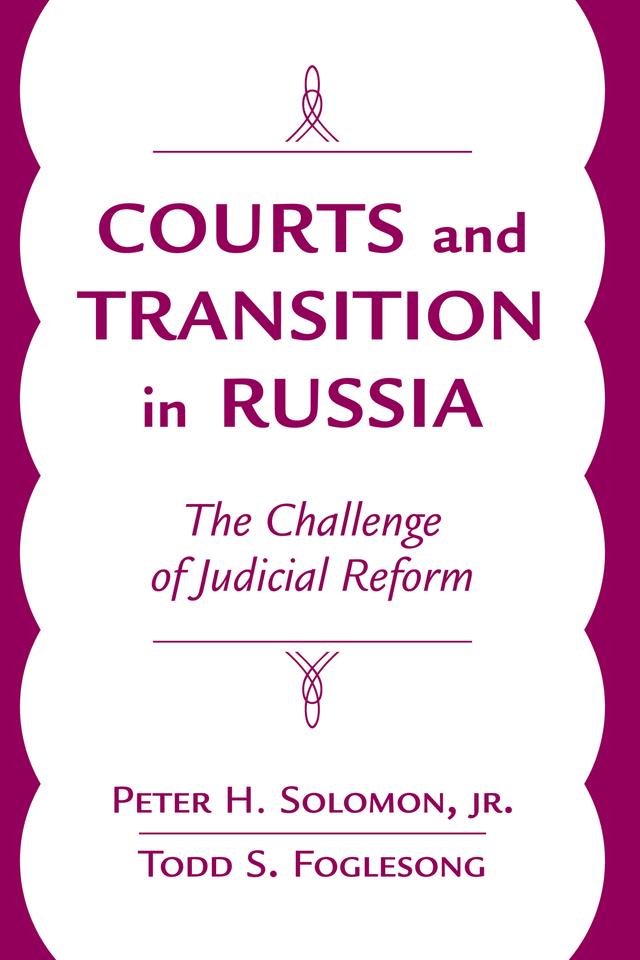
It is hardly a revelation to say that in the Soviet Union, law served not as the foundation of government but as an instrument of rule, or that the judiciary in that country was highly dependent upon political authority. Yet, experience shows that effective democracies and market economies alike require courts that are independent and trusted. In Courts and Transition in Russia, Solomon and Foglesong analyze the state and operation of the courts in Russia and the in some ways remarkable progress of their reform since the end of Soviet power. Particular attention is paid to the struggles of reformers to develop judicial independence and to extend the jurisdiction of the courts to include constitutional and administrative disputes as well as supervision of pretrial investigations. The authors then outline what can and should be done to make courts in Russia autonomous, powerful, reliable, efficient, accessible and fair. The book draws upon extensive field research in Russia, including the results of a lengthy questionnaire distributed to district court judges throughout Russian Federation.Written in a clear and direct manner, Courts and Transition in Russia should appeal to anyone interested in law, politics, or business in Russia ? scholars and practitioners alike ? as well as to students of comparative law, legal transition, and courts in new democracies.
Płać wygodnie kartą, Klarną, Apple Pay lub Google Pay. Nie jesteś zadowolony? Zawsze masz 14-dniową gwarancję zwrotu pieniędzy. Więcej przeczytasz w naszych warunkach. Masz pytania? Napisz do nas na hello@memmo.org.
Memmo ułatwia naukę – gdziekolwiek jesteś na świecie. U nas znajdziesz podręczniki i sprytne narzędzia do nauki w jednym miejscu: streszczenia, quizy, podcasty i fiszki. A do tego Ted, Twój kumpel do nauki, który odpowie na wszystko, co Cię nurtuje. Ponad 50 000 studentów już tu się uczy – stworzone, byś uczył się szybciej i mniej stresował.
Może Ci się spodobać
Kup książkę0